

Why Does Moisture Accumulate in Compressor Tanks?
Every industrial air system generates measurable water during the compression process. If you ignore draining moisture from air compressor tanks, the accumulated condensate causes internal rust and expensive equipment failure. As Anglian Compressors, we help facilities manage this byproduct efficiently.
This post explains the correct drainage methods, UK environmental regulations, and the difference between manual and automatic valves.
Why Does Moisture Accumulate in Compressor Tanks?
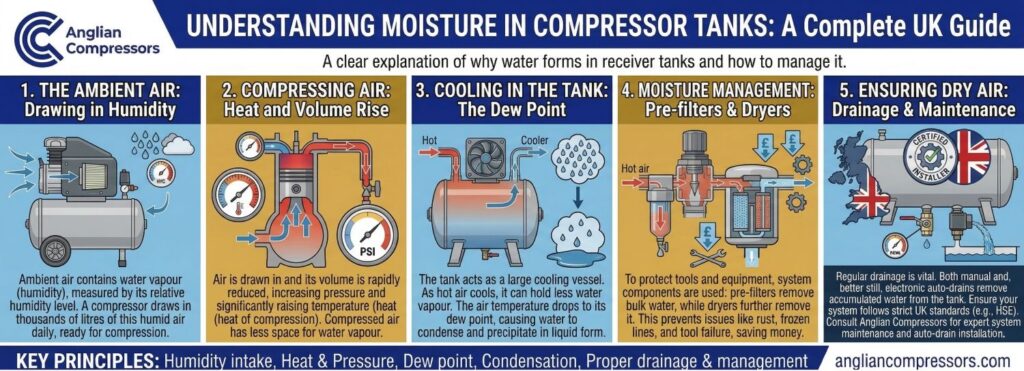
Moisture builds up because compressing air concentrates atmospheric water vapour into a smaller volume. This raises its pressure dew point. As the hot compressed air cools against the receiver tank walls, it loses its ability to hold this moisture in vapour form. This forces it to condense into liquid water.
The intake air always contains humidity, but the volume reduction during compression magnifies the water content per cubic metre. This issue is particularly acute in the UK, where high relative humidity often averages over 80% in winter. This significantly increases the total water load entering your system. A standard 30 kW compressor can generate nearly 40 litres of condensate per day in humid conditions.
Understanding this process requires distinguishing between Atmospheric Dew Point (ADP) and Pressure Dew Point (PDP). ADP is the temperature at which water condenses at normal ambient pressure. PDP is the temperature at which condensation occurs while the air is pressurised. Since compression raises the dew point, water condenses at much higher temperatures inside the system.
Several factors determine exactly how much liquid collects in your receiver:
- Inlet temperature: Warmer air holds more moisture before compression.
- Ambient humidity: Higher moisture levels in the intake air increase condensate volume.
- Operating pressure: Higher pressures squeeze more water out during the cooling phase.
Most modern industrial air compressors include internal aftercoolers to remove the bulk of this liquid. But, the receiver tank remains a critical collection point. Since this condensate poses serious threats to your system, we must examine the specific risks involved.
Is Moisture Putting Your Business at Legal and Operational Risk?
Untreated moisture creates three distinct liabilities: operational downtime from rusted equipment and safety violations under PSSR 2000 due to vessel corrosion. It also risks unlimited fines for illegal environmental discharge of oil-contaminated condensate. Ignoring these risks transforms a simple mechanical byproduct into a major financial threat for your facility.
When water mixes with compressor oil and atmospheric dust, it forms an abrasive sludge. This acidic mixture blocks pneumatic valves and washes away required lubricants in air tools. This significantly shortens their lifespan. For sensitive applications like powder coating, even microscopic moisture droplets cause immediate product spoilage and expensive rework.
The safety implications are strictly regulated. Standing water in your air receiver accelerates internal corrosion. This reduces the vessel’s wall thickness over time. If a certified engineer detects this thinning during your statutory inspections, the vessel will fail immediately. Under the Pressure Systems Safety Regulations 2000, you cannot legally operate a compromised pressure vessel.
Environmental compliance presents the third risk tier. Compressor condensate is never just water. It contains up to 1,000 ppm of oil. This classifies it as hazardous waste.
The Three Tiers of Moisture Risk:
- Operational: Sludge formation blocks valves and ruins pneumatic tools.
- Safety: Internal rust leads to PSSR 2000 inspection failures.
- Environmental: Discharging oily water into drains violates the Water Resources Act 1991.
Pouring this condensate directly into foul sewers or surface drains attracts heavy fines from the Environment Agency. To mitigate these risks, operators must understand the correct procedures for manual drainage.
How Do You Safely Drain a Tank Manually?
Safely draining a tank manually requires wearing hearing protection and isolating the system before slowly opening the valve. You must capture this liquid in a sealed container rather than allowing it to spill onto the workshop floor. Regular compressor maintenance ensures these valves remain functional and safe to operate.
Compressed air receivers store immense energy and require respect during maintenance. Under the Pressure Systems Safety Regulations 2000, operators must be competent in these tasks to avoid injury from pressurised discharge. We recommend following a strict procedure to manage the condensate volume safely.
- Locate the valve: Find the manual ball valve situated at the bottom of the receiver tank.
- Control the flow: Open the valve slowly to release water without creating a high-pressure jet.
- Seal the system: Close the valve immediately once the liquid stream turns to air to minimise pressure loss.
Standard units like the Atlas Copco G series feature accessible drains for this exact purpose. But relying on daily manual intervention often leads to skipped checks and water buildup. To eliminate the risk of human error, we must examine the devices that remove water automatically.
Which Drain Type Is Best: Manual, Timer, or Electronic?
The Electronic Water Drain (EWD) is the superior choice for industrial efficiency because it removes moisture without venting valuable compressed air. Manual drains are inexpensive but carry a high risk of flooding if forgotten. The timer drains waste energy by opening even when the system is dry.
Manual valves are the default option on many receiver tanks. They are simple to operate but rely entirely on a strict maintenance schedule. If an operator forgets to open the valve, water builds up rapidly. This leads to corrosion inside the tank and potential liquid carryover into your tools.
Timer drains automate the process but lack intelligence. They open at fixed intervals regardless of how much condensate is actually present. If the valve opens for ten seconds but the water drains in two, you waste eight seconds of compressed air energy. This constant air loss increases your electrical costs significantly over time.
We recommend upgrading to an EWD from Atlas Copco. Their EWD units use capacitive sensing technology to monitor fluid levels inside the collection reservoir. The valve opens only when water is present and closes immediately after drainage. This ensures zero air loss and maximum energy savings.
Drain Type Comparison
| Drain Type | Initial Cost | Energy Efficiency | Risk Factor |
| Manual | Low | Low (Human Error) | High (Flooding) |
| Timer | Medium | Medium (Wastes Air) | Low |
| EWD | High | High (Zero Loss) | Lowest |
For facilities that need 24/7 reliability, we can connect these devices to SMARTLINK remote monitoring to track drain activity. While drains handle liquid water, we must also address water vapour and oil separation using ancillary components.
How Do Ancillary Components Prevent Moisture Buildup?
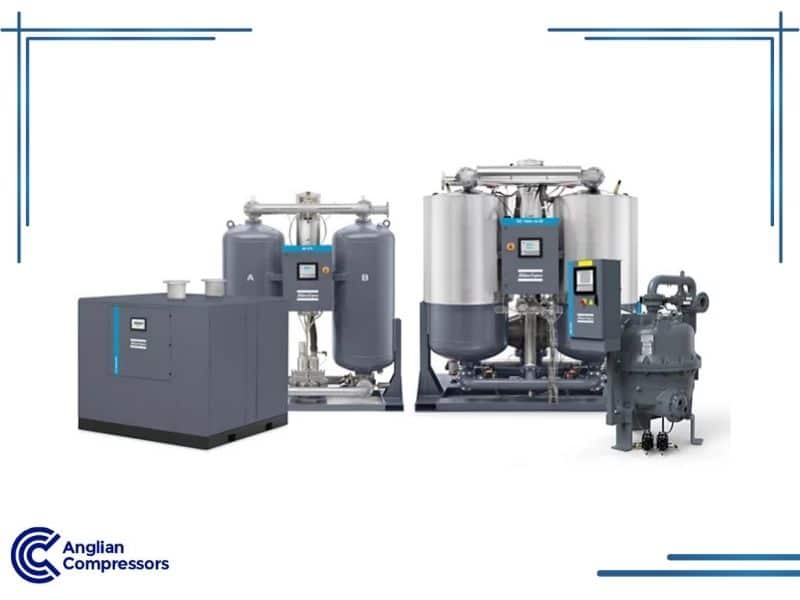
Ancillary components prevent moisture buildup by actively lowering the pressure dew point (PDP) of compressed air before it reaches your tools. While drains remove liquid, air dryers extract water vapour suspended in the gas. Specialised piping materials stop corrosion from creating new moisture traps downstream.
Choosing the right dryer depends entirely on your air quality requirements. For standard industrial tasks, a refrigerant dryer typically maintains a PDP of +3°C to prevent condensation. For critical applications like pharmaceuticals, we install desiccant dryers to achieve dew points between -40°C and -70°C.
Managing the liquid waste is equally important. An oil-water separator (OSC) filters the condensate removed by your drains. This device separates trace oil from water. This ensures compliance with the Water Resources Act 1991 before you discharge fluid into the sewer system.
Finally, the material of your distribution network matters. We recommend AIRnet aluminium piping over traditional galvanised steel. Steel pipes corrode when exposed to residual moisture. This creates rough surfaces that trap water and restrict flow.
- Refrigerant Dryers: Best for indoor factories (+3°C PDP).
- Desiccant Dryers: Essential for sub-zero environments (-40°C PDP).
- AIRnet Piping: Eliminates corrosion risks associated with steel.
While moisture is inevitable, effective management is key for protecting your equipment. Automating with electronic water drains significantly reduces costs and guarantees regulatory compliance to avoid fines. Contact our Peterborough team today to upgrade your drainage setup or schedule a complete system audit to reduce downtime.