

What Does an Air Compressor Regulator Do?
Controlling the pressure in any system is key to its safe and efficient operation. For compressed air, delivering air at a pressure that is too high for the application wastes thousands in energy costs and risks damaging expensive equipment.
At Anglian Compressors, our certified engineers have spent over 40 years advising businesses across the UK on how to optimise their systems for performance and savings. We know that understanding what an air compressor regulator does is the first step towards better control.
This guide explains how these components work, the different types available, and how to set them up correctly for your tools.
What Does an Air Compressor Regulator Do?
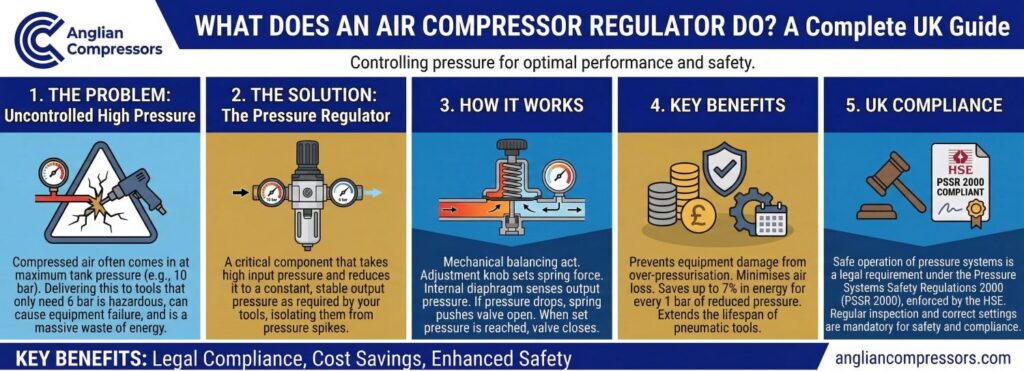
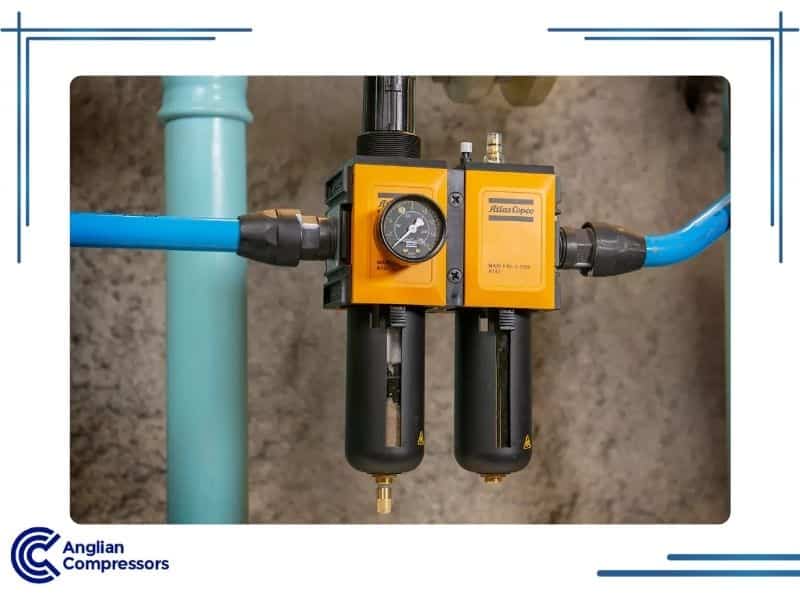
An air compressor regulator, also known as a pressure reducing valve (PRV), controls and lowers the high-pressure air from a receiver tank to a consistent, usable pressure for your equipment. It is the critical component that ensures the downstream pressure matches the specific requirements of your tools. This prevents damage and improves safety. Without it, your system is inefficient and dangerous.
Running tools at a pressure higher than needed is a common mistake. It exposes them to full tank pressure – often over 150 PSI – which causes rapid wear and tear. We frequently find that fluctuating air pressure damages pneumatic tools when a system lacks proper pressure control.
A properly set regulator performs three primary jobs:
- Protect Tools: It prevents over-pressurisation from destroying seals and internal components in equipment like nail guns or CNC machines.
- Save Energy: It reduces wasted air consumption. In fact, reducing the pressure by just 1 bar can cut your energy costs by around 7%.
- Ensure Safety: It helps you meet the requirements of PSSR 2000 by controlling pressure at the point of use. Our expert compliance services can help you manage these complex legal obligations.
This precise control is not just a mechanical feature – it is fundamental to the safety and efficiency of your entire operation.
Why Is Controlling Air Pressure So Important?
Controlling air pressure is critical because it directly affects workplace safety, energy consumption, and equipment performance. Without a regulator providing a stable, correct downstream pressure, you risk creating safety hazards, running up huge electricity bills, and damaging expensive tools. It is one of the most fundamental aspects of designing an efficient compressed air distribution system.
The benefits of precise pressure control fall into three main categories:
- Safety and Compliance: Maintaining a safe operating pressure is a legal requirement under the Pressure Systems Safety Regulations 2000 (PSSR 2000). This is enforced by the Health and Safety Executive – the UK’s national regulator for workplace health and safety. It prevents system over-pressurisation and potential component rupture.
- Energy Efficiency: Generating compressed air is expensive. Any pressure higher than what is needed creates artificial demand and wasted energy. A thorough energy audit can identify where incorrect pressure settings are costing your business money.
- Equipment Protection: Fluctuating air pressure can damage pneumatic air tools and sensitive machinery that rely on a consistent supply. Unregulated pressure leads to inconsistent performance and premature wear.
Failing to manage your system’s pressure effectively introduces unnecessary risk and cost into your operations.
How an Air Compressor Regulator Works
An air compressor regulator uses a spring-loaded diaphragm and valve to automatically reduce the high, fluctuating inlet pressure from the compressor tank to a lower, stable downstream pressure. This internal mechanism creates a force-balance system that isolates your equipment from pressure swings happening inside the air receiver. The principle is a continuous mechanical balancing act between a spring pushing down and air pushing back up.
The process happens in a fraction of a second through a few key steps:
1. Set Pressure: The operator turns the adjustment knob, which compresses a control spring to a specific tension. This spring applies a measured downward force on a flexible diaphragm.
2. Valve Opening: The diaphragm pushes open a small poppet valve. This allows high-pressure air to flow from the inlet to the outlet.
3. Force Balance: As pressure builds on the outlet side, it pushes up against the underside of the diaphragm, opposing the spring’s force.
4. Regulation: When the outlet pressure force equals the spring force, the valve closes just enough to maintain the set pressure. If downstream air use causes the pressure to drop, the spring immediately pushes the valve open again to compensate.
This self-adjusting process ensures your tool receives a constant, specified pressure, even if the main tank pressure drops. If this mechanism fails, our nationwide team offers expert air compressor repair services to get your system back up and running safely.
Are All Air Compressor Regulators The Same?
While the basic principle is common, not all air compressor regulators are the same. They are different components engineered for specific applications, flow rates, and levels of precision. A regulator designed for a small dental surgery will fail if installed on a heavy industrial airline, so choosing the right one is essential for performance and safety.
The primary differences between models can be broken down into a few key areas:
- Operating Principle: Most regulators are either direct-operated (spring-loaded) or pilot-operated. Pilot-operated models use air pressure itself to help control the main valve, making them suitable for higher flow applications.
- Flow Rate (CFM): This determines how much air can pass through the regulator without a measurable pressure drop. It can range from under 50 CFM to over 1000 CFM.
- Pressure Range: Standard units might operate up to 10 bar. Specialist models from manufacturers like Norgren can handle much higher pressures.
- Port Size: This dictates how it connects to your pipework. Common sizes range from 1/4 inch for point-of-use applications to 2 inches or more for main distribution lines.
Understanding these differences is the first step, but the most common choice you will face is between two main functional types. Our team can supply a wide range of regulators and spare parts to match any system requirement.
Should You Choose a Relieving or Non-Relieving Regulator?
The two main categories are relieving and non-relieving regulators. Your choice depends entirely on whether your application needs to vent excess downstream pressure automatically. A relieving regulator is designed for dynamic systems where you need to reduce pressure on the fly, as it can release trapped air. This is the most common type for general pneumatic applications.
A non-relieving regulator, in contrast, cannot vent this trapped air. If the downstream pressure exceeds the set point, it will remain high until the system bleeds it off through normal operation. They are used where venting the medium, such as an inert gas or a liquid, is not desirable or safe.
The key differences are straightforward.
| Feature | Relieving Regulator | Non-Relieving Regulator |
| Venting Mechanism | Automatically vents excess downstream pressure. | Does not vent. It traps downstream pressure. |
| Best For | General pneumatics, air tools, frequent adjustments. | Static pressures, inert gases, liquids, sealed systems. |
| Pressure Control | Allows for active downward pressure adjustment. | Pressure can only be reduced by system use. |
| Typical Use Case | A paint spray gun requiring precise, variable control. | A CNC machine’s pneumatic chuck needing constant force. |
For most compressed air systems, a relieving regulator is the standard choice. If you are unsure which is right for your process, our engineers can provide expert advice.
How to Set and Adjust Your Air Compressor Regulator
Setting your regulator correctly is important for protecting your tools and ensuring efficiency. Always refer to your tool’s manual for the recommended operating pressure (PSI or bar). Setting the pressure too high is a common cause of premature wear.
Follow these steps for safe and accurate adjustment:
1. Isolate the Regulator: Close the shut-off valve upstream of the regulator to stop air from flowing to it.
2. Vent Downstream Pressure: Safely vent any trapped air in the line downstream of the regulator. On a relieving regulator, you can do this by turning the adjustment knob fully counter-clockwise.
3. Access the Knob: Most regulators have a locking mechanism on the adjustment knob. You may need to pull it up or push it down to access it.
4. Reset to Zero: Turn the adjustment knob counter-clockwise until it feels loose and the spring is no longer under tension. The gauge should read zero.
5. Slowly Open the Air Supply: Gently open the upstream shut-off valve to supply the regulator with air from the tank.
6. Increase the Pressure: Slowly turn the adjustment knob clockwise. Watch the downstream pressure gauge rise until it reaches the desired pressure for your tool.
7. Lock the Setting: Once the correct pressure is set, push the knob back down or into its locked position to prevent accidental changes.
Correct installation and adjustment are just as important as selecting the right model. Getting this wrong can undermine the safety and efficiency of your entire system.
Get Expert Advice on Your Compressed Air System
An air compressor regulator is a small but essential component for controlling output pressure. It protects your tools, saves energy, and ensures your system operates safely. For any business using compressed air, it is a non-negotiable part of a professional setup.
Choosing the right type is critical, but ensuring it is installed and set correctly is where professional expertise makes all the difference. For specialist help selecting, installing, or servicing the right regulator for your system, speak to the Anglian Compressors team. We offer expert advice and nationwide support to keep your operations running efficiently and safely.