

The Top 5 Air Compressor Mistakes Costing UK Businesses Thousands
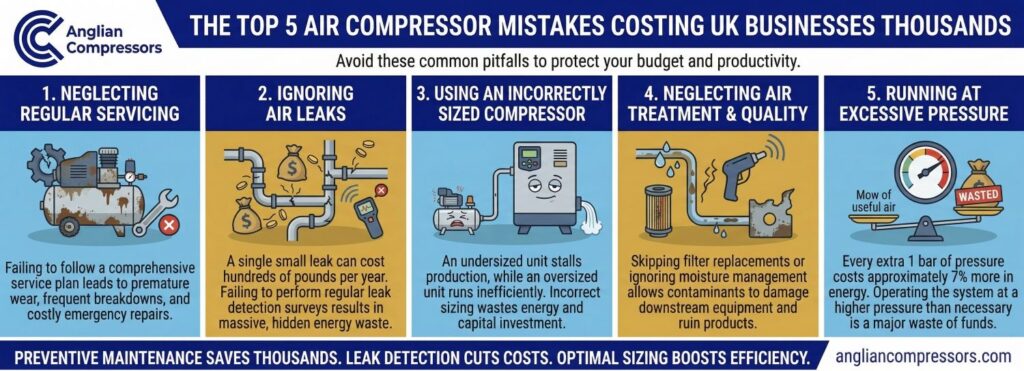
The top air compressor mistakes to avoid are rarely obvious – but a poorly managed compressed air system can waste up to 50% of its energy output, making it one of the most expensive utilities in your facility. Knowing what those mistakes are is the difference between a system that pays for itself and one that silently drains your operating budget.
Anglian Compressors have been Atlas Copco Premier Distributors since 1977 (and are now a branch of Atlas Copco Compressors) and hold CHAS and SafeContractor accreditation as a Competent Person under PSSR 2000. This article covers the five most damaging mistakes our engineers see across the UK industry and the engineering-led fixes for each.
Mistake #1: Is Your Compressor Room Sabotaging Your System?
The compressor room is not just a housing space – it’s an active component of your cooling system. A poorly ventilated room recirculates hot exhaust air, forcing the machine to work harder to cool itself and accelerating mechanical wear.
The Critical Role of Compressor Ventilation
Air-cooled compressors are designed to operate at ambient temperatures below 40°C. For every 10°C rise above that threshold, lubricant oxidation rate around doubles – reducing oil service life from 4,000 hours to under 2,000 hours, turning a scheduled annual fluid change into a liability requiring attention every six months.
Compressor placement matters beyond temperature. Locating a unit near steam sources, paint booths, or chemical processes allows contaminants to coat the cooler fins with a sticky residue that compressed air alone can’t remove, requiring professional chemical cleaning to restore thermal efficiency. So the HSE guidance on safe installation (hse.gov.uk) sets out the baseline requirements for compressor room design.
Choosing the Right Pipe Size and Material
Choosing the wrong pipe size or material is one of the fastest ways to introduce pressure drop and contamination into an otherwise well-specified system. Undersized pipework creates a pressure drop, forcing the compressor to work at a higher set point to compensate. Traditional steel pipework corrodes internally, releasing rust flakes that clog filters and destroy seals in pneumatic cylinders throughout the plant.
Modern modular aluminium piping, such as AIRnet, eliminates corrosion entirely and maintains consistent bore dimensions, reducing pressure loss across the distribution network.
A professional site survey and ISO 11011-compliant AIRScan energy audit from our team identifies these foundational installation issues before they become failures.
Mistake #2: Ignoring ‘The Saturation Paradox’ and Poor Air Treatment
Compressed air always contains water. The UK’s maritime climate, with relative humidity regularly exceeding 80%, makes moisture management one of the most pressing air treatment challenges in British industry.
Why ‘Dry’ Air Becomes Saturated with Water
When ambient air is compressed, its volume shrinks, but its moisture content doesn’t. A 55 kW compressor operating in typical UK conditions can produce over 250 litres of liquid condensate per day. That water corrodes air receivers internally, washes lubricant from pneumatic tools, and freezes in external pipework during winter months.
A single corroded receiver that fails a PSSR inspection requires immediate decommissioning; the replacement cost for a 500-litre vessel typically exceeds £2,000, excluding lost production. Multi-stage drainage – water separators at discharge, automatic drains on the receiver tank, and downstream refrigerant or desiccant dryers – is the only reliable defence.
The Financial and Compliance Risks of Oil Carry-Over
Oil carry-over is a separate but related problem. In food production environments governed by BRCGS/HACCP protocols, or medical gas applications covered by HTM 02-01, even trace oil contamination can trigger a product recall or regulatory breach.
A blocked or failing oil/water separator backs oily condensate into the air receiver. This re-enters the air stream, scouring pipework and destroying pneumatic valve seals – one of the most common air compressor failures our engineers attend. Under the Water Resources Act 1991, discharging untreated oily condensate can result in unlimited fines.
Our ZR/ZT series oil-free compressors and multi-stage filtration systems deliver air purity up to ISO 8573-1 Class 0, meeting the strictest process requirements.
Mistake #3: Why is ‘More Pressure’ One of the Most Expensive Air Compressor Mistakes?
Running your system at higher pressure than your process needs is a direct and measurable financial loss – and one of the most common responses to a system underperforming for other reasons.
The 7% Rule: How Over-Pressurisation Inflates Your Energy Bill
Every 1 bar reduction in system pressure reduces energy consumption by around 7%. If your compressor is set at 8 bar to compensate for pressure drop caused by undersized pipework or blocked filters, you are paying a 7-14% energy premium on every cubic metre of air produced. To reduce air compressor costs, address the root cause – not the pressure setting.
Variable Speed Drive technology – available in VSD, VSD+, and VSDˢ variants from the Atlas Copco GA range – automatically matches motor speed to actual air demand, eliminating the artificial pressure band that fixed-speed machines need.
Hunting for Hidden Costs: The Impact of Air Leaks
A single 6.4 mm leak in a system operating at 7 bar can cost over £4,044 annually in wasted electricity at typical UK industrial rates. Most facilities have multiple leaks. Turning up the pressure to mask leakage compounds the cost rather than solving it.
Our ultrasonic leak detection survey and energy audit pinpoints these invisible losses and provides a written report with projected payback periods – typically within months.
Mistake #4: Are You Voiding Your Warranty? The True Cost of Skipping Maintenance and Using Non-Genuine Parts
Skipping scheduled maintenance doesn’t just risk a breakdown – it transfers the financial liability for that breakdown entirely onto your business.
Beyond the Manual: What ‘Regular Maintenance’ Really Means
Most operators are aware of the need for filter and oil changes at 2,000 and 4,000 hours. Fewer know that the 8,000-hour service needs re-kitting of the unloader valve and Minimum Pressure Valve (MPV). A failed MPV allows air to flow back from the plant into the compressor on shutdown, blowing oil out through the intake filter – a precursor to air end seizure.
Our air compressor maintenance guide details the full service schedule for the Atlas Copco GA series and other major brands.
The Hidden Dangers of ‘Will-Fit’ Spares
A genuine Atlas Copco oil separator is engineered to an oil carry-over rate of under 3 ppm. A non-genuine ‘will-fit’ part may look identical but carry over 10 ppm or more, coating the heat exchanger inside your air dryer and allowing wet, oily air to enter your plant.
Using non-genuine compressor lubricants or parts voids the manufacturer’s warranty. An air end replacement on a mid-range GA unit can exceed £15,000. Our service plans use only genuine OEM spares, performed by manufacturer-trained engineers, keeping your warranty intact.
Mistake #5: Ignoring Your Compressor’s Data and Safety Obligations
A modern compressor controller is a diagnostic instrument. Treating it as an on/off switch means ignoring early warning data that prevents catastrophic failure.
Decoding Your Compressor’s Controller
The Atlas Copco Elektronikon controller logs specific fault codes that identify failure modes before they escalate. An F21 code shows a motor overload trip, which could signal anything from a dropped phase in the UK power supply to the early stages of an air end seizure. Acting on that code immediately costs nothing.
Ignoring it can cost everything.
SMARTLINK remote monitoring captures live performance data and identifies trends – such as a gradual rise in discharge temperature indicating a slowly clogging cooler. Our SMARTLINK service watches your system 24 hours a day, seven days a week.
PSSR 2000: More Than Just an Explosion Risk
Under the Pressure Systems Safety Regulations 2000 (PSSR), any system with a pressure x volume product over 250 bar litres needs a Written Scheme of Examination and periodic inspection by a Competent Person. The internal inspection of an air receiver assesses corrosion caused by condensate – that internal rust weakens the tank and enters the air stream as abrasive particulate, destroying pneumatic valve seals and cylinder bores across the plant. PUWER Regulations add a further layer of compressor safety obligations for work equipment.
As a Competent Person under PSSR 2000, Anglian Compressors, a Branch of Atlas Copco Compressors, delivers Written Schemes of Examination and periodic inspections – managing your full legal compliance obligation directly.
Before you do anything else, walk to your air receiver and press the test button on the electronic drain. If you don’t hear a strong blast of air and water, it’s blocked – and your system is already at risk. Book a complimentary site survey with our engineers, and we will identify your system’s hidden efficiency losses and compliance gaps, at no cost and no obligation.
Frequently Asked Questions
What Are the Common Air Compressor Faults?
The most common faults are overheating from blocked coolers or poor compressor ventilation, excessive moisture from failed air treatment equipment, and electrical trips. The Atlas Copco Elektronikon logs specific fault codes for each issue, and SMARTLINK remote monitoring tracks these before a minor fault causes a major failure.
Who Makes the Most Reliable Air Compressors?
Brands including Atlas Copco, HPC Kaeser, Ingersoll Rand, and CompAir all have strong reputations. Reliability depends more on correct installation, proper air treatment, and consistent maintenance with genuine compressor lubricants than on brand alone.
What Is the Most Common Cause of Compressor Failure?
Overheating – typically caused by not enough compressor ventilation, a clogged oil cooler, or degraded compressor lubricants. Thermal stress breaks down the oil and causes the air end’s rotors to seize, a repair that frequently exceeds £15,000 and results in extended downtime.
How Can I Get More Performance from My Compressed Air System?
Fix all air leaks, lower system pressure to the true minimum your tools need, and verify that pipe size is adequate to prevent pressure drop. These steps deliver more usable air at the point of use without over-stressing the compressor or increasing your energy bill.