

Stopping Corrosion Inside Air Compressor Tanks
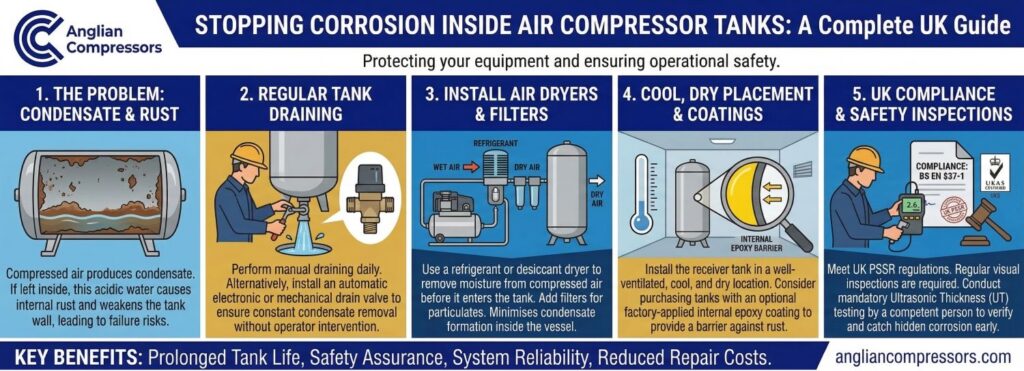
The condensate pooling at the bottom of your air compressor tank is not pure water. It’s a mildly acidic solution containing dissolved CO₂ and SO₂, actively attacks the carbon steel walls from the inside. But stopping corrosion inside air compressor tanks is both a maintenance priority and a legal obligation under UK law.
Anglian Compressors, a Branch of Atlas Copco Compressors, has been an Atlas Copco Premier Distributor since 1977 and holds ‘Competent Person’ status under PSSR 2000. This article covers how moisture forms, why it causes structural and downstream damage, how to remove it, and which treatment systems apply to your operation.
Why Does Water Form Inside a Compressor Tank?
Compressed air always contains water vapour. The compression process concentrates the vapour, and the subsequent cooling phase forces it into liquid form, collecting at the bottom of your air receiver tank.
The Thermodynamics of Condensation
When air is compressed to 8 bar (800 kPa), its volume reduces to one-eighth of its original state. The water vapour mass stays constant, so its partial pressure increases sharply. During compression, heat keeps the vapour in a gaseous state.
Once the air enters the aftercooler or receiver and cools below the pressure dew point (PDP), that vapour condenses into liquid water.
This condensate is not chemically neutral. Atmospheric gases, including CO₂ and SO₂, dissolve into it, forming weak carbonic and sulphuric acids, lowering the pH of the liquid sitting against your tank wall and accelerating pitting corrosion that standard wall-thickness checks can miss until structural integrity is already compromised.
Quantifying the Moisture Problem
A 55kW rotary screw compressor operating at 75% relative humidity and 24°C ambient temperature can generate upwards of 280 litres of liquid water every 24 hours – a continuous throughput of corrosive fluid, not a drip. Our iiTrak and AIRScan energy audit services quantify the full impact of moisture mismanagement on your system’s energy consumption, giving you measurable data to act on.
The Real Dangers of Internal Rust in Your Air Compressor
Internal rust is not cosmetic. When moisture causes rust and scale inside a carbon steel receiver, the consequences range from abrasive downstream contamination to criminal liability for the site operator.
From Rust to Rupture: PSSR 2000 Compliance
The Pressure Systems Safety Regulations 2000 (PSSR 2000) require any pressure system where vessel volume (litres) multiplied by maximum working pressure (bar) exceeds 250 bar-litres to operate under a Written Scheme of Examination (WSE). The WSE must be created by a ‘Competent Person’ and mandates regular internal inspections.
Failure to comply is a criminal offence under Section 33 of the Health and Safety at Work etc. Act 1974. HSE intervention, prosecution, and director-level liability are all live consequences.
A PSSR inspection confirms wall thickness is above the minimum safe threshold today – it doesn’t confirm your tank is not actively shedding abrasive rust scale into your production line.
Downstream Contamination: The Hidden Cost of Corrosion
Most operators assume a passed PSSR inspection means their system is safe. It doesn’t. Iron oxide flakes detach from corroded tank walls and travel downstream at line pressure.
Inside pneumatic cylinders, they act as a grinding paste against piston seals. Inside directional control valves, they block fine orifices. Inside air tools, they accelerate wear on moving parts – a tank can pass its statutory inspection while simultaneously destroying thousands of pounds of downstream equipment.
Our AIRScan audit identifies exactly this type of downstream contamination damage, mapping the condition of your distribution system and flagging components already compromised by rust scale. As a ‘Competent Person’ under PSSR 2000, our engineers create your WSE and perform the statutory inspections your system legally needs.
How Can You Remove Water Before It Causes Rust?
Aftercoolers and water separators provide the first line of defence, removing 60-70% of total moisture content by forcing vapour into liquid form at the compressor discharge. What remains must be actively drained and managed.
Intelligent Draining vs Wasteful Draining
Three drain valve types are in common use across UK industrial sites.
| Drain Type | How It Works | Key Weakness |
| Manual | Operator-opened | Frequently forgotten |
| Timed Solenoid | Opens on a timer | Wastes compressed air when dry |
| Electronic Zero-Loss (EWD) | Opens only when full | Higher upfront cost |
Timed solenoid drains open regardless of condensate level. A single unit can waste over £1,000 per year in electricity generating compressed air that’s immediately vented. Atlas Copco EWD series zero-loss drains use capacitive sensors to open only when the reservoir is full, paying back their cost in energy savings – often within 12 months.
The Legal Duty: Managing Oily Condensate
Condensate from oil-lubricated compressors is classified as hazardous trade effluent under the Water Resources Act 1991 and the Environmental Protection Act 1990. Discharging it untreated to drain is a criminal offence. Atlas Copco OSC series oil-water separators use multi-stage polypropylene and activated carbon filtration to reduce oil content to below 15 ppm, meeting the UK legal discharge threshold.
We supply and install the full condensate management chain – from EWD zero-loss drains to OSC separators – keeping your system both dry and legally compliant.
Which Air Treatment System Is Right for Stopping Corrosion?
Draining the tank treats the symptom. Installing the correct compressed air dryers removes water vapour before it can condense, addressing the cause directly.
Refrigerated vs Desiccant Dryers
Refrigerated dryers cool compressed air to a stable Pressure Dew Point (PDP) of +3°C, forcing residual moisture to condense before the air enters distribution. They suit the majority of general industrial applications in the UK. Atlas Copco FD VSD refrigerated dryers match refrigeration compressor speed to actual air demand, reducing energy consumption by up to 50% compared to fixed-speed units.
Desiccant dryers use twin towers of adsorbent material to achieve PDPs of -40°C or -70°C, and are mandatory where pipework runs through unheated spaces or where process requirements demand ultra-dry air. Heatless desiccant dryers consuming 15-20% purge air on a 37kW system waste around 5.5-7.4kW continuously – around £3,500-£5,000 per year at average UK industrial electricity rates. Specifying the correct dew point for your actual application avoids this cost entirely.
Industry-Specific Considerations (Food, Pharma, Medical)
Food production sites operating under BRCGS/HACCP frameworks and NHS facilities governed by HTM 02-01 need oil-free compressed air meeting ISO 8573-1 Class 1 or Class 2 purity. Atlas Copco ZR/ZT series oil-free compressors combined with desiccant drying deliver this standard. Our engineers specify the correct combination for your regulatory framework.
The Importance of Pipework Design
BCAS Best Practice Guideline 101 recommends a minimum pipe gradient of 1:100 on all horizontal runs, directing condensate toward low-point drains. Swan-neck take-offs from the top of the main header prevent water from entering drop legs, and drip legs at each point of use collect residual moisture before it reaches tools. AIRnet aluminium modular piping doesn’t corrode internally, eliminating the zinc and iron oxide flakes that galvanised steel generates over time.
Your Expert Partner in Corrosion Prevention and PSSR Compliance
Our Credentials and Accreditations
Anglian Compressors, a Branch of Atlas Copco Compressors, has operated as an Atlas Copco Premier Distributor since 1977. We hold CHAS and SafeContractor accreditations and align our installation practices with BCAS (British Compressed Air Society) best practice guidelines. Our engineers hold ‘Competent Person’ status under PSSR 2000, qualifying them to produce your Written Scheme of Examination.
Multi-Brand Service Capability
Our manufacturer-trained engineers service all major makes, including Atlas Copco, Ingersoll Rand, HPC Kaeser, and CompAir. You are not required to operate Atlas Copco equipment to benefit from our compliance and maintenance services.
Predictive Maintenance with SMARTLINK
SMARTLINK monitors over 30 operational parameters in real time, including pressure dew point and filter differential pressure. When a dryer begins to degrade, SMARTLINK triggers an alert before moisture reaches your distribution system – rather than weeks later when water appears at the point of use and damage is already done. Our tailored service plans combine SMARTLINK monitoring with proactive maintenance visits to keep your system safe, dry, and compliant.
Check the manual drain at the bottom of your air receiver now. If more than a small amount of water comes out, your automatic drain has likely failed. Book a no-obligation site assessment with one of our engineers to evaluate your system’s corrosion risk and confirm your PSSR 2000 compliance.
Frequently Asked Questions
How to Prevent Rust in an Air Compressor Tank?
Install a functioning zero-loss automatic drain to remove liquid water daily. Add a refrigerated dryer for general use or a desiccant dryer for critical applications. Maintain your PSSR 2000 inspection schedule to catch early-stage corrosion before it progresses.
Can You Coat the Inside of an Air Compressor Tank?
Some manufacturers offer epoxy or glass-lined tanks as a factory option. Retroactively coating a standard steel tank is not recommended – coating failure produces flakes that contaminate air tools. Upstream air treatment through dryers and coalescing filters is more reliable and cost-effective.
How to Clean Inside an Air Compressor Tank?
Cleaning a pressure vessel is specialist work carried out under a formal WSE by a ‘Competent Person’. It needs full depressurisation and isolation before internal access. Chemical cleaners are not advised as they can damage the steel.
Prevention through correct drainage and drying is always preferable.
How Often Should an Air Compressor Tank Be Inspected for Corrosion?
Your WSE under PSSR 2000 dictates the inspection frequency – typically annually or biennially for most industrial air receivers, depending on age, operating environment, and condition history.