

Proper Storage for Air Compressors
The most damaging thing you can do to a compressor is nothing at all. Proper storage for air compressors is not a passive state; it is an active, scheduled discipline. A static compressor corrodes from the inside, loses its bearing protection, and can return from storage in worse condition than a machine that ran continuously for the same period.
Compressed air is the fourth utility: when it fails on restart, production stops.
Anglian Compressors (a Branch of Atlas Copco Compressors) holds Competent Person status under PSSR 2000, and is CHAS and SafeContractor accredited. This guide covers every stage of compressor storage, preparation, environment, type-specific protocols, legal obligations, and recommissioning.
Why Storing an Air Compressor Is Never as Simple as Switching It Off
A running compressor is a self-protecting system. Heat drives off moisture, oil circulation prevents corrosion, and shaft rotation maintains elastohydrodynamic lubrication films. So switch it off, and all three protective barriers collapse simultaneously.
As a compressor cools, contracting internal air draws in ambient moisture through intake filters and breathers. That moisture condenses on ferrous surfaces, initiating electrochemical oxidation. Motor winding insulation absorbs water vapour, reducing dielectric strength.
Rust inhibitors and anti-wear agents precipitate from stagnant oil, forming sludge that clogs the oil filter at startup and starves bearings of lubrication.
False Brinelling, Hydrolysis, and the Diesel Bug: Three Failure Modes Most Operators Miss
False brinelling doesn’t need the machine to move, it needs the machine to be stationary while the surrounding environment vibrates. A forklift operating 10 metres away transmits enough micro-oscillation through a concrete slab to fret bearing raceways over weeks, producing rapid fatigue failure on restart.
In synthetic oils, hydrolysis splits ester molecules into organic acids that attack bearings. In diesel XAS Series portable units, Hormoconis resinae (the diesel bug) colonises the fuel-water interface, corroding tank bottoms and injection surfaces. Replacing a seized 90 kW air end can exceed £10,000 (based on Anglian Compressors’ service records).
This is always avoidable with correct preparation.
Our engineers carry out pre-storage condition assessments across our 150-mile service radius from Peterborough, identifying false brinelling risk, oil degradation, and WSE compliance gaps before a machine goes offline.
How Should You Prepare Your Air Compressor for Storage?
Preparation is the single most impactful intervention in any air compressor maintenance routine.
The Pre-Shutdown Oil Change: Why Fresh Oil Is Non-Negotiable
Never store a compressor with dirty oil. Used oil contains acids, emulsified water, and metal particulates that etch surfaces during static storage. After draining and replacing the oil filter, fill with Roto Synthetic Fluid ULTRA (Part # 1630 2041 05 / 20) – a PAO-based synthetic with a 4,000-hour or 2-year service life, correct for long-term storage of GA/G Series units.
Then run the compressor on load for 30-60 minutes (Atlas Copco GA Series Service Manual).
That run time is not arbitrary. The thermostatic bypass valve only opens when oil temperature exceeds 75°C (Atlas Copco GA Series Service Manual). Run for only 5-10 minutes and the oil cooler remains filled with acidic waste oil, corroding the tubes from the inside out, a critical failure where BS EN ISO 8573-1 air purity is a contractual requirement.
Draining the Air Receiver, Disconnecting AIRnet Pipework, and Sealing the System
Drain the air receiver tank fully. Condensate is classified as hazardous waste under the Hazardous Waste (England and Wales) Regulations 2005, requiring consignment notes for all movements. Disconnect from downstream AIRnet pipework, close the discharge valve, and isolate from the primary power source.
Seal the air inlet and discharge flanges with heavy-gauge plastic after VCI fogging, maintaining a closed internal environment. On belt-drive GX Series units, loosen V-belt tension, leaving belts under load causes permanent shape memory and places static load on motor bearings.
Our engineers stock genuine OEM fluids and filters at our Peterborough warehouse, covering all pre-storage preparation steps under a single visit.
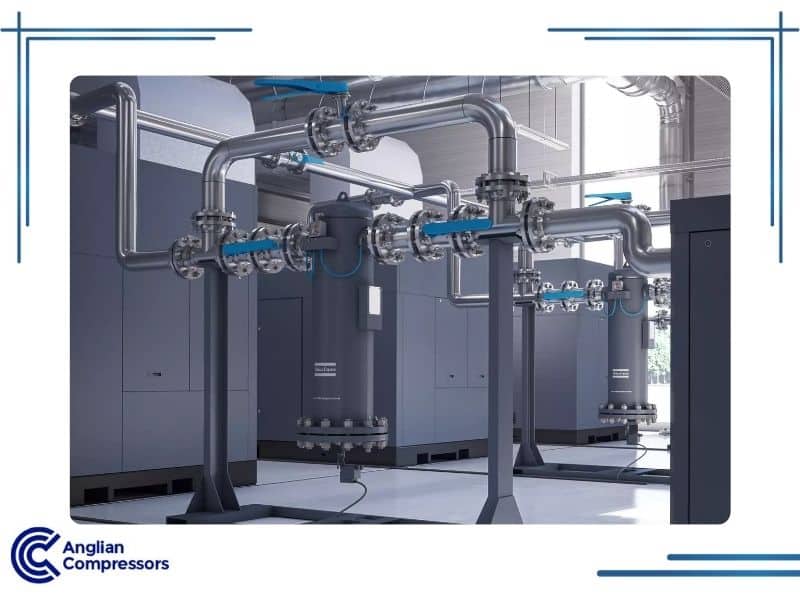
Choosing the Right Storage Space for Your Air Compressor
Temperature, Humidity, and the 7°C Rule
Maintain storage temperature above 7°C. Below this threshold, residual condensate freezes, seals cracks, and moisture condensation increases sharply during UK spring and autumn temperature swings. Our guide on how to winter-proof your compressed air system covers freeze protection in detail.
An unventilated room becomes progressively more humid as temperature fluctuates, drawing humid air deeper into the machine with each cooling cycle. Motor winding insulation resistance can fall below 1 MΩ within six months in a poorly ventilated space (Atlas Copco Electrical Installation and Maintenance Guidelines), creating a phase-to-ground fault risk indistinguishable from a manufacturing defect without a pre-storage Megger test record. Correct air storage conditions need a temperature above 7°C and controlled humidity.
Place silica gel desiccant bags inside control cabinets and check the colour indicator monthly: pink means saturated, blue means active.
Vibration Isolation and the Risk of Placing Your Compressor Room Near Heavy Plant
Store equipment on rubber matting or wooden blocks to decouple it from ground-transmitted vibration. Never store standby units adjacent to reciprocating compressors, punch presses, or high-traffic forklift routes. Atlas Copco Z Series (ZR/ZT) oil-free units need a dust-free and oil-free storage space, contamination voids BS EN ISO 8573-1 Class 0 certification.
AIRCUBE containerised systems offer a genuine advantage here, keeping the internal environment sealed against moisture ingress.
If your primary compressor enters storage during a facility move, our Air Compressor Hire Fleet provides electric and diesel rental units across our 150-mile service radius to maintain supply without interruption.
Does Your Compressor Type Change How You Store It?
Yes, fundamentally. A protocol that protects an oil-injected screw compressor can destroy an oil-free unit.
Oil-Injected GA/G Series and Oil-Free Z Series: Fundamentally Different Protocols
For GA/G Series oil-injected units, remove the intake filter, spray VCI preservation oil into the inlet while manually rotating the drive coupling, then seal both flanges. Rotate the drive shaft 3-5 complete turns monthly to prevent false brinelling and redistribute the oil film.
For Z Series (ZR/ZT) oil-free units, don’t spray oil or VCI liquids into the intake; these react with PTFE or molybdenum disulfide rotor coatings, causing swelling or peeling. Use silica gel or activated alumina desiccant bags sealed inside intake and discharge piping, and attach a prominent warning tag: “REMOVE DESICCANT BAGS BEFORE STARTING.” Rotate the drive shaft 3 complete turns weekly – more frequent than oil-injected units due to the absence of an oil film.
For GA VSD+ compressors, power the VSD drive (without running the motor) for 1 hour every 6-9 months (Atlas Copco VSD Drive Service Manual). Electrolytic capacitors in the DC bus degrade when unpowered. A GA 75 VSD+ inverter module failure costs £4,000-£8,000 to replace (based on Anglian Compressors service records) and takes the compressor offline for days, eliminating the energy savings that justified the VSD investment in the first place.
Portable XAS Diesel Units: Fuel Stability, ATEX Compliance, and the Exhaust Cap
Fill the fuel tank to the brim to minimise ullage and reduce condensation on tank walls. Treat with a broad-spectrum biocide and run the engine for 15 minutes to circulate treated fuel to the injection pump. Seal the exhaust pipe tip; rainwater entering a vertical exhaust stack flows past open exhaust valves directly into the cylinder, causing hydraulic lock and piston seizure.
Verify ATEX certification status before placing any XAS unit into storage in a classified zone.
What Does UK Law Actually Require When You Store a Pressure System?
The HSE guidance on Pressure Systems Safety Regulations 2000 applies to any compressed air system above 0.5 bar, and switching a compressor off doesn’t pause your legal obligations.
PSSR 2000: The Difference Between ‘Switched Off’ and ‘Out of Service’
A compressor that is switched off but remains pressurised is legally still in service under PSSR 2000. To be legally out of service for storage, the system must meet all three of the following conditions:
- Isolate from the energy source and the downstream network.
- Depressurise to atmospheric pressure.
- Drain all condensate.
The Written Scheme of Examination (WSE) clock doesn’t stop when the machine does. PSSR 2000 Regulation 8 needs examination intervals independent of operational status. A compressor stored for 14 months that was due for a statutory examination at month 12 can’t legally return to service without a new Competent Person examination, regardless of physical condition.
Restarting without that examination exposes the duty holder to HSE enforcement action and potential prohibition notices.
Environmental Obligations: Condensate, Hazardous Waste, and the Water Resources Act
Oily condensate must not be discharged to surface water or sewer under the Water Resources Act. On-site OSC/OSS oil-water separators treat condensate to the required standard. Bunded storage at 110% of container volume is mandatory for any oil stored on-site, even temporarily.
As a PSSR 2000 Competent Person, Anglian Compressors (a Branch of Atlas Copco Compressors) can review your WSE before storage begins and schedule the recommissioning inspection under a fixed-price Service Plan.
Recommissioning After Storage: The Checks That Prevent a Costly Restart Failure
The oil stop valve, a spring-loaded check valve that prevents oil from flooding the air end when depressurised, can stick closed after months of static storage. On a GA 37 or larger, the air end then runs dry for the first 10-30 seconds at full compression pressure, scoring rotor surfaces within the first minute of operation.
The Pre-Start Inspection Checklist
Remove all seals, tape, and desiccant bags from intake and discharge piping before any attempt to start. Drain a small oil sample from the sump low point: a cloudy appearance or acrid smell means water contamination, change the oil before starting. Manually operate the safety relief valve pull ring to confirm it moves freely.
A seized valve is a PSSR 2000 compliance failure and a physical hazard. Perform a motor insulation resistance (Megger) test; a reading below 1 MΩ shows damp windings requiring drying before full voltage is applied.
How to Check Your Compressor Is Ready to Return to Service
Prime oil-injected units by pouring 0.5-2 L of clean oil directly into the unloader valve. Bump-start the motor for 1-2 seconds and listen for abnormal mechanical noise before committing to a full start. Run unloaded for 15-20 minutes, monitoring oil temperature until it reaches the thermostat opening point.
To complete a safe return to service, work through the pre-start checklist above before applying full load. This is how you confirm your compressor restarts without incident. If storage has crossed the WSE examination due date, a Competent Person inspection is legally required before the system returns to service.
Our 24/7 Breakdown Cover and Professional Inspection service is specifically recommended for compressors returning from long-term storage, providing a documented recommissioning record that satisfies both PSSR 2000 and your own maintenance audit trail.
Before contacting anyone, check your Written Scheme of Examination right now, confirm the next statutory examination date and compare it against your planned storage duration. If storage will cross that date, you have a legal obligation to act before the machine goes offline.
Book a pre-storage preservation inspection or a recommissioning check with Anglian Compressors (a Branch of Atlas Copco Compressors). Call our Peterborough team or request a service visit online across our full 150-mile service radius.
Frequently Asked Questions
How to properly store an air compressor?
Change to Roto Synthetic Fluid ULTRA for GA Series units, drain the air receiver, isolate from the power source and AIRnet pipework, seal the intake and discharge, and rotate the drive shaft monthly. Confirm your WSE examination date before the machine goes offline. Compressor storage is an active maintenance discipline, not a passive state.
Should you store an air compressor full or empty?
The oil sump should be full of fresh preservation fluid. The air receiver must be empty and fully drained; a pressurised receiver remains legally in service under PSSR 2000. On diesel XAS units, fill the fuel tank to the brim to minimise condensation on tank walls.
Is it okay to store an air compressor outside?
Possible for short periods with correct preparation, but high-risk in the UK climate. Freeze-thaw cycles crack seals, UV degrades cable insulation, and humidity accelerates corrosion. If unavoidable, seal all openings, use a weatherproof cover, maintain battery charge on diesel units, and apply the 7°C temperature rule.
Should you store an air compressor with the valve open?
No. Close the discharge valve and seal the intake after VCI fogging (oil-injected units) or desiccant placement (Z Series). Fully depressurise before sealing; a pressurised system with a closed valve remains legally in service under PSSR 2000.
How long can you store an air compressor before it needs servicing?
Check the VCI preservation oil condition at 6 months and perform a motor insulation resistance test at the same interval. VSD capacitors need energisation every 6-9 months. The WSE examination interval under PSSR 2000 continues regardless of operational status, if storage crosses the due date, a Competent Person inspection is legally required before restart.
Can you store a VSD compressor for more than a year?
Yes, with a specific protocol. Power the VSD drive for 1 hour every 6-9 months to prevent electrolytic capacitor degradation in the DC bus. If that interval has been missed, consult the Atlas Copco VSD drive manual for the capacitor reforming procedure. A professional inspection before recommissioning any VSD unit stored beyond 12 months is strongly recommended.