

How Ambient Temperature Affects Air Compressor Performance
Facilities managers tend to notice temperature problems late. A production line falters, someone checks the compressor, and the discharge temperature is running 15°C above normal. The machine’s been struggling for weeks.
Temperature is the one variable that changes everything else: how much air a compressor actually delivers, how fast the oil degrades, whether the VSD electronics derate themselves, and whether the condensate drains freeze solid on a January morning. Understanding the relationship gives you a maintenance advantage before something fails.
Anglian Compressors, a Branch of Atlas Copco Compressors, has been managing these seasonal patterns across East Anglia and the Midlands since 1977. This guide covers the mechanics of how temperature affects your system, and what to do about it before the seasons turn.
Why the Temperature Window 5°C to 30°C Is Your Baseline
Air compressors are designed to operate optimally between 5°C and 30°C. Every degree outside that window costs you efficiency, accelerates component wear, or creates outright mechanical risk.
The physics is straightforward. Compressors don’t compress volume; they compress mass. Hot air is less dense than cold air.
A GA 55 drawing in air at 35°C pulls in less mass per stroke than one running at 20°C, even though the rotors displace the same volume.
| Inlet Temperature | Effect on Output | Key Risk |
|---|---|---|
| Below 5°C | Density bonus of ~2% per 5.5°C drop | Oil thickening, condensate freezing |
| 5°C to 30°C | Optimal operating range | Minimal, normal maintenance |
| 30°C to 40°C | ~2% capacity loss per 5°C rise | Accelerated oil degradation |
| Above 40°C | Significant capacity loss + VSD derating | Overheating, shutdown risk |
Cold Air Brings a Density Bonus and Mechanical Risks
Every 5°C rise in inlet temperature reduces output by approximately 2%. For a 100 kW machine at full load, that’s a measurable drop in Free Air Delivery before you’ve touched a single parameter.
In winter, the opposite is true. Cooler, denser air increases the mass flow available to the system. A 5.5°C drop in inlet temperature improves mass delivery by roughly 2%.
The density advantage is real. The problem is that cold oil is thick, cold condensate freezes, and cold electronics condense.
You only get the benefit if the system is protected against what comes with it.
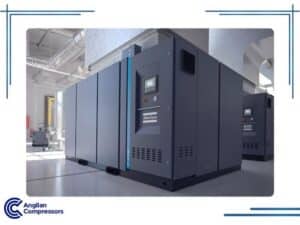
How Ambient Temperature Affects Air Compressor Performance
What High Ambient Temperatures Do to Oil, Electronics, and Cooling
Above 30°C, three failure mechanisms accelerate in parallel: lubricant oxidation shortens drain intervals and risks varnish formation. VSD drives start derating their current output. And air-cooled heat exchangers lose efficiency as the approach temperature closes.
Compressor oil doesn’t fail all at once. It degrades chemically. The Arrhenius Rate Law describes this precisely: the rate of oxidation approximately doubles for every 10°C rise above the rated operating temperature.
Roto-Xtend Duty Fluid is rated at 8,000 hours with a discharge temperature around 85°C to 90°C. Push that to 105°C through poor ventilation, and the effective oil life drops to 4,000 hours. At 115°C, it’s 2,000 hours.
How Oil Degradation Becomes a Feedback Loop
Degraded oil forms varnish. That varnish coats the oil cooler internals, reducing heat transfer efficiency, which pushes the discharge temperature higher. It’s a feedback loop that ends in unplanned downtime.
How VSD Electronics Respond to Heat
Atlas Copco GA VSD+ compressors are rated for ambient conditions up to 46°C, with the Neos Next inverter holding full performance at 50°C. Standard competitor VSDs typically begin derating above 40°C.
When the ambient temperature approaches the thermal limit, the Elektronikon controller reduces maximum motor RPM rather than tripping the machine off. The compressor continues to deliver partial flow through a heatwave instead of shutting production down. That graduated response is a deliberate design choice, one that matters on a 35°C afternoon in a poorly ventilated plant room near Northampton.
Why Cooling System Performance Drops in Summer
Air-cooled compressors remove heat by blowing ambient air across the oil cooler and aftercooler. The efficiency of this process is measured by approach temperature, the difference between the discharge air temperature and the ambient cooling air.
A standard cooler designed for an 11°C approach will deliver 46°C discharge air when the plant room is at 35°C. That same machine runs at 30°C discharge in winter. The extra heat carries downstream into the dryer, stresses distribution pipework, and can exceed the temperature ratings of pneumatic seals and downstream filters.
| Ambient Temperature | Discharge Temperature | Dryer Inlet Load | Risk Level |
|---|---|---|---|
| 15°C (winter) | ~26°C | Standard | Low |
| 25°C (spring/autumn) | ~36°C | Elevated | Manageable |
| 35°C (summer heatwave) | ~46°C | High | Monitor closely |
| 40°C+ (hot plant room) | ~51°C | Critical | Dryer capacity exceeded |
Activated carbon filter lifetime is cut by up to 90% when ambient temperature rises from 20°C to 40°C. Oil carryover into the airline can increase to 20 times the specified value at that range. These aren’t edge cases for industrial sites in Lincolnshire or Northamptonshire running continuous production, they’re summer maintenance facts.
How Cold Weather Creates a Different Set of Failures
Cold ambient temperatures shift the failure pattern entirely. Instead of chemical degradation, the risks are physical: oil too thick to circulate, condensate that freezes solid, and moisture condensing on electronics when a hot compressor shuts down in a cold room.
Three components fail first in cold weather:
- Auto-drains: float mechanisms freeze solid, causing water carry-over into the airline
- Sensing lines: small-bore tubes to pressure transducers ice up, blinding the controller
- Oil separator tank: condensate accumulates and emulsifies into sludge if the oil never reaches the operating temperature
Cold Starting: Motor and Lubrication Risks
Oil viscosity increases sharply below 15°C. On a near-freezing start, the motor must overcome immense resistance from oil that’s moved closer to the consistency of treacle. That spike in inrush current can trip circuit breakers or overload star-delta starters.
If the motor does start, there’s a brief window of inadequate lubrication before the oil warms and begins circulating properly.
The Emulsification Problem: Oil and Water
In cold conditions, a compressor may run cool enough that the discharge temperature never reaches the threshold needed to flash water vapour out through the aftercooler. When that happens, condensate collects inside the oil separator tank and mixes with the oil.
The result is a white-grey sludge that looks like mayonnaise. It clogs oil filters, corrodes the air-end element, and destroys the lubricating film that protects bearings and rotors. We’ve opened separator tanks in January on East Midlands sites and found the fluid almost unrecognisable.
Atlas Copco’s Smart Temperature Control (STC) addresses this by dynamically adjusting oil injection temperature. On cold starts, it restricts flow to the oil cooler until the oil reaches the temperature needed to carry moisture through the system rather than letting it settle out.
Auto-drains are the most common cold-weather failure point. A frozen float drain is invisible from the outside, the machine runs normally, but condensate backs up through the filter bowl and pushes liquid water into the airline. Checking and manually testing every drain before the temperature drops is one maintenance task that consistently prevents reactive callouts.
Atlas Copco’s Smart Temperature Control and VSD+ Technology
The GA VSD+ combines an interior permanent magnet motor cooled by the main oil circuit with the Neos Next inverter built in-house for compressor duty, giving it a thermal advantage that off-the-shelf drive systems can’t match.
The iPM motor design is significant here. Because the motor is oil-cooled rather than air-cooled, its operating temperature tracks the main oil circuit rather than the plant room ambient.
A traditional air-cooled induction motor relies on a fan blowing plant air across the frame. In a 40°C room, that motor runs hot regardless of load. The iPM motor doesn’t.
SMARTLINK remote monitoring plays a specific role in temperature management. It tracks discharge temperatures, ambient sensor readings, and oil condition flags across every connected machine.
We’ve had SMARTLINK flag a rising discharge temperature trend on a GA 37 near Spalding, six degrees over three weeks, still within normal range but heading in the wrong direction. We replaced a partially blocked oil cooler on a planned visit. Without the trend data, that visit would have happened after a shutdown.
| Seasonal Priority | Task | Why It Matters |
|---|---|---|
| Pre-summer | Clean oil cooler and aftercooler counter-flow | Dust acts as insulation; reduces cooling efficiency |
| Pre-summer | Clean VSD cabinet intake filters | Starves drive of cooling air; causes derating |
| Pre-summer | Check ventilation dampers set to exhaust | Recirculating hot exhaust doubles ambient temperature |
| Pre-winter | Test all auto-drains manually | Frozen drains push water into airline undetected |
| Pre-winter | Verify trace heating on exposed condensate lines | Ice blocks are invisible until the thaw |
| Pre-winter | Check cabinet heaters in Elektronikon enclosure | Condensation on PCBs causes phantom faults |
| Year-round | Monitor discharge temperature trend via SMARTLINK | Gradual rises indicate cooler or oil degradation before failure |
Preparing Your Compressor Room for UK Seasonal Extremes
Ventilation design is where temperature management succeeds or fails. A 100 kW air-cooled compressor rejects approximately 94 kW of heat into the room. Without a designed airflow to remove it, the compressor room temperature tracks upward until the machine trips.
Warning signs your ventilation is failing:
- Discharge temperature is rising steadily without a corresponding increase in demand
- Compressor trips on high temperature during hot weather, but not in winter
- Damper set to winter recirculation mode during summer
- Inlet air temperature in the compressor room is more than 10°C above the outdoor ambient temperature
The target is to maintain the compressor room at no more than 10°C above outdoor ambient. In a hot summer when outdoor temperatures reach 28°C, the room should stay below 38°C. That requires active calculation, not simply opening a door.
Ducting dampers are the mechanism that makes compressor room ventilation design work across seasons. In summer, hot exhaust air from the cooler discharge should be ducted directly outside. In winter, that same exhaust, often at 40°C to 45°C, redirected into the factory floor offsets heating costs and helps the machine maintain operating temperature.
The most common failure with this system is a damper stuck in winter mode during summer. The hot exhaust recirculates back to the compressor inlet, compounding the ambient temperature problem. If a compressor is running consistently hot without an obvious cause, check the damper position before replacing components.
Under the Pressure Systems Safety Regulations 2000 (hse.gov.uk), a Written Scheme of Examination defines the safe operating limits for the system, including temperature boundaries. Operating consistently outside those limits is a compliance matter, not just a maintenance one.
Anglian Compressors holds PSSR Competent Person status. If overheating is affecting your statutory inspection, our engineers can assess it alongside the service visit.
For systems in environments that experience both summer peaks and freezing winters, food processing in Lincolnshire, logistics centres near Milton Keynes, pharmaceutical labs in the Cambridge corridor, winter-proofing compressed air systems and summer preparation aren’t separate programmes. They’re a single annual cycle, timed to the seasons.
Anglian Compressors, a Branch of Atlas Copco Compressors, covers every site within 150 miles of our Peterborough base, including all East Anglia and the Midlands. Whether you need a pre-summer cooler clean, a condensate drain audit before winter, or SMARTLINK monitoring to track temperature trends year-round, our engineers service all makes, not just Atlas Copco.
Frequently Asked Questions
How Does Ambient Temperature Affect the Air Compressor?
Ambient temperature affects three things simultaneously: air density and output (hot air is less dense, reducing Free Air Delivery), lubricant condition (higher temperatures accelerate oxidation via the Arrhenius rate law), and cooling efficiency (as ambient temperature rises, the aftercooler’s approach temperature closes, pushing discharge temperatures higher). Cold temperatures introduce oil viscosity problems on startup and condensate freezing risks. The optimal operating window is 5°C to 30°C, with every 5°C rise above that reducing output by approximately 2%.
Does Cold Weather Affect Air Compressors?
Yes, significantly. The main cold-weather failure modes are:
- Oil thickening on startup: increases torque demand, risks brief lubrication starvation
- Emulsification: if the machine runs too cool, condensate mixes with oil to form a white sludge
- Frozen drains: auto-drains and sensing lines ice solid, pushing water into the airline undetected
See our guide to cold weather on compressors for a detailed pre-winter checklist.
What Technology Ensures Effective Performance in High Ambient Temperatures?
Atlas Copco GA VSD+ compressors use three specific technologies for high ambient operation:
- High Ambient algorithm: Elektronikon reduces RPM gradually rather than tripping the machine as temperatures approach the limit
- Neos Next inverter: built in-house, full performance to 50°C versus 40°C derating threshold for third-party drives
- iPM motor: oil-cooled, so motor temperature tracks the oil circuit rather than the plant room air
The combination means partial flow through a heatwave rather than a production stop.