

Air Compressor Not Building Pressure: Common Causes & Fixes
An industrial air compressor that fails to build pressure cannot reach its programmed cut-out level, preventing the delivery of sufficient compressed air to connected equipment. This condition arises when air generation is lower than air loss caused by leaks, internal bypass, control faults, or excessive downstream demand, resulting in reduced efficiency, higher energy consumption, and operational disruption.
This article provides a structured diagnostic framework to identify whether pressure loss originates within the compressor or elsewhere in the system, enabling operators and maintenance teams to apply corrective action efficiently and in line with UK regulatory requirements.
Diagnostic Outcomes: Isolation Testing
Isolating the compressor from the plant is the primary diagnostic action. This is achieved by closing the main discharge valve to separate the compressor from the air receiver and distribution pipework.
- Condition A: Compressor reaches target pressure and unloads. The fault is located downstream. This indicates that pressure loss originates from distribution leaks or a demand-capacity mismatch within the facility.
- Condition B: Compressor fails to reach pressure against a closed valve. The fault is internal. This indicates a failure within the compressor pump, the intake regulation, or the internal control circuit.
Volumetric Efficiency as a Diagnostic Indicator
Volumetric efficiency (Ev) is the ratio of actual Free Air Delivery (FAD) to the theoretical displacement of the compressor pump. A significant drop in Ev confirms that the motor is driving the pump, but air is escaping internally during the compression cycle.
Reduced volumetric efficiency directly increases energy consumption per unit of air produced. When Ev falls, the compressor must run for longer periods to meet demand, leading to accelerated wear and higher electricity expenditure.
Diagnostic measurement of Ev differentiates between internal mechanical wear and external system losses. In rotary screw compressors, low efficiency points to increased rotor clearances or lubricant degradation. In reciprocating models, it typically indicates failing valve plates or piston ring bypass.
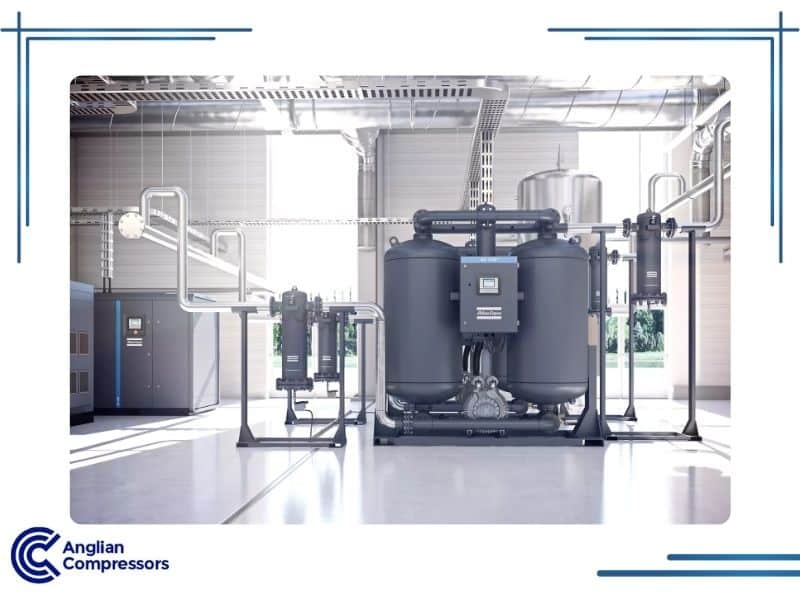
Rotary Screw Compressor Failure Modes
Rotary screw compressors, such as the Atlas Copco GA series, utilise specific pneumatic and electrical logic to manage air production. Specific symptoms differentiate these component-level faults.
Unloader Valve and Solenoid Logic
The unloader valve regulates the intake of ambient air. The Elektronikon controller signals the Y1 solenoid valve to apply or vent control air to actuate this valve. A failure in the solenoid coil or stuck valve seals results in a compressor that runs continuously without a rise in pressure. The machine remains in an “unloaded” state and does not draw in air.
Minimum Pressure Valve (MPV) Dynamics
The MPV is located at the discharge of the oil separator vessel. It remains closed until internal pressure reaches approximately 4 bar to ensure sufficient lubricant circulation. An MPV stuck open prevents the compressor from building internal pressure against an empty air net. An MPV stuck closed causes internal pressure to spike until the safety valve lifts, while discharge pressure remains at zero.
Oil Separator Differential Pressure
A saturated or collapsed oil separator element acts as a physical restriction. This fault results in high internal pressure readings while the discharge pressure remains low. The separator effectively blocks the flow of air into the distribution line.
Reciprocating Compressor Failure Modes
Piston-based systems are susceptible to mechanical fatigue within the cylinder head and drive assembly.
- Valve Plate Carbonisation: Heat and oil carryover cause carbon build-up on the reed or plate valves. This prevents a tight seal, allowing compressed air to leak back into the cylinder or intake.
- Gasket Integrity: Blown head gaskets create a direct leak path to the atmosphere, preventing the accumulation of pressure within the tank.
- Drive Belt Slippage: Glazed or loose drive belts slip under load. This prevents the pump from reaching the RPM required to meet the system’s Cubic Feet per Minute (CFM) rating.
UK Climate and Environmental Factors
The UK’s high relative humidity introduces specific regional failure risks for compressed air systems.
- Oil Emulsification: High moisture levels can turn compressor lubricant into a milky emulsion. This fluid fails to seal the gaps between screw rotors, leading to a direct drop in compression efficiency and built-up pressure.
- Frozen Control Lines: During winter months, undrained condensate in control lines can freeze. This ice blocks the pneumatic signals required to actuate the unloader valve. Guidance on preventing these issues is found in the winter-proof your compressed air system technical guide.
Economic Impact of Pressure Misdiagnosis
Incorrectly diagnosing pressure loss leads to significant energy waste. In the UK, approximately 35% of compressed air energy is lost through unmanaged leaks.
Attempting to compensate for a pressure drop by increasing the compressor’s setpoint results in “artificial demand.” Every 1 bar of unnecessary pressure increase raises energy costs by approximately 7%. A structured professional leak detection survey identifies downstream losses that often mimic compressor failure, ensuring maintenance efforts are directed at the actual source of loss.
Regulatory Compliance and Safety (PSSR 2000)
Compressed air systems in the UK are subject to the Pressure Systems Safety Regulations 2000 (PSSR). Duty holders are legally responsible for maintaining the system within safe operating limits.
- Legal Liability: Unauthorised interventions or repairs to pressure-holding components can breach PSSR 2000 and invalidate the Written Scheme of Examination (WSE).
- Enforcement: Non-compliance exposes duty holders to HSE enforcement, prohibition notices, or insurance complications.
- Medical Risk: High-pressure air carries severe risks. Compressed air entering the bloodstream or tissue can be fatal even at relatively low system pressures.
Maintenance Governance: Intervention Thresholds
A clear boundary exists between operator-level checks and professional engineering requirements.
- Operator-Level Actions: Basic visual inspections, monitoring Elektronikon error codes (such as 3080 or 3130), and isolation testing fall within safe operator boundaries.
- Engineer-Level Intervention: Structural mechanical faults, internal valve replacements, and pressure-switch calibrations require intervention by a certified engineer to preserve safety, warranty, and PSSR compliance.
Implementing a structured air compressor maintenance programme using SMARTLINK remote monitoring and AIRScan audits is the most effective method for identifying root causes and preventing repeat pressure failures. Contact us today.