

Understanding Single-Stage vs. Two-Stage Air Compressors
Compressed air is essential for many UK companies in manufacturing, automotive repair, and agriculture. It is as vital as gas, water, and electricity, and choosing between a single-stage and a two-stage compressor is important for efficiency and energy savings.
This guide discusses the best options for different applications and emphasises the need for reliability and compliance based on your facility’s needs.
How Compressors Work
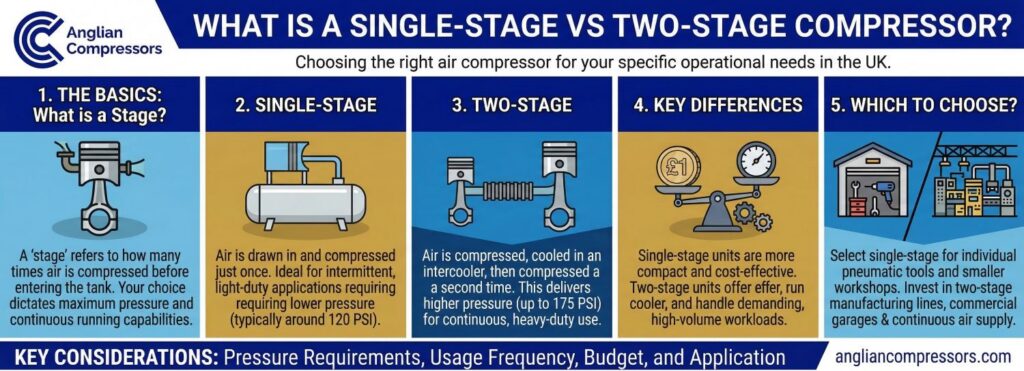
Single-stage and two-stage compressors can essentially be broken down into reciprocating and piston compressors. They are positive displacement compressors that work by forcing air into a cylinder and using a piston to reduce the volume, raising the internal pressure. The main difference lies in how many times this process occurs before the air reaches the receiver tank.
One Stage or Two
How a Single-Stage Compressor Works
Single-stage air compressors complete the compression process in one stroke. The cylinder fills with atmospheric air, and a piston compresses the air to its target pressure, usually up to 135 PSI or 9.3 bar. The compressed air is then released directly into a storage tank.
How a Two-Stage Compressor Works
A two-stage compressor uses an intercooler to boost efficiency by compressing air in two phases:
- First Stage: Air is compressed to an intermediate pressure in a large, low-pressure cylinder. This initial compression produces heat.
- Intercooling: Before the final compression, hot air cools as it passes through an intercooler.
- Second Stage: After cooling, the denser air enters a second, smaller high-pressure cylinder and is compressed again to reach a higher pressure, typically 12 bar or 175 PSI. In the second stage, less energy is needed to compress the cooler, denser air treated by the intercooler. This process also improves air quality by reducing moisture.
Stages vs. Cylinders
The number of cylinders can be confused with the number of stages. A single-stage compressor can have multiple cylinders, but they will all be the same size and perform the same compression task.
You can identify a two-stage compressor by two main features:
- Different Cylinder Sizes: The low-pressure cylinder (first stage) is larger than the high-pressure cylinder (second stage).
- An Intercooler Pipe: This is a finned tube linking the two cylinder heads.
A Technical Breakdown of Atlas Copco Compressor Designs
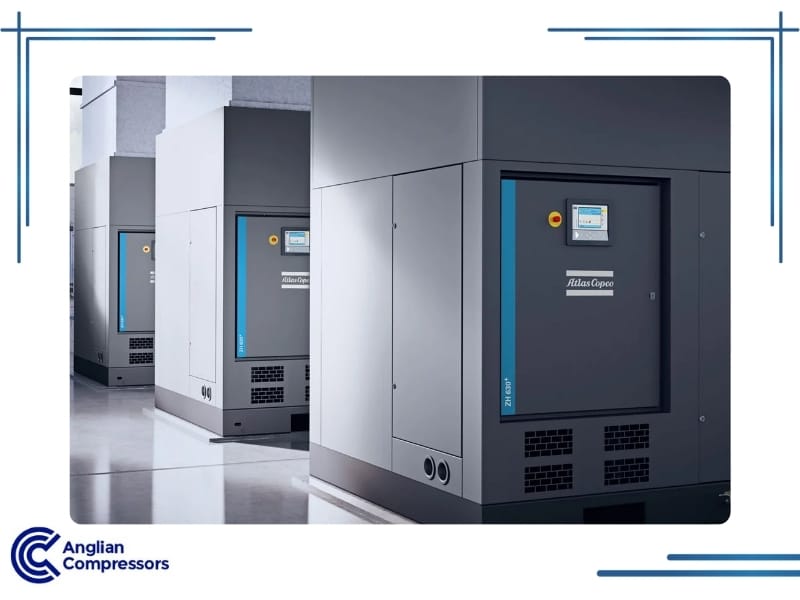
Atlas Copco’s LE and LT piston compressors provide reliable single-stage and two-stage performance for efficient operation and easy servicing. For continuous-use environments, the GA VSD⁺ rotary screw series combines multi-stage compression benefits with smart motor control that cuts energy use by up to 50%.
All Atlas Copco systems are also compatible with SMARTLINK remote monitoring.
Which is Right for Your Business?
Choosing the right type of air compressor depends on your application’s requirements:
- Pressure (PSI/Bar): Single-stage compressors generally deliver up to 135 PSI, which is suitable for tools like nail guns and small impact wrenches. Two-stage compressors maintain 175 PSI or more, which is necessary for sandblasting, truck tire tools, and heavy industrial equipment.
- Airflow (CFM): For the same power input (HP/kW), two-stage compressors produce 15-20% more cubic feet per minute (CFM) of air than single-stage compressors, due to their higher efficiency. This allows multiple tools to operate simultaneously without pressure drops.
- Duty Cycle: Duty cycle matters; single-stage compressors have a duty cycle of about 50-70% and are meant for occasional use. Running a single-stage compressor continuously leads to overheating and early failure. On the other hand, two-stage compressors are built for constant industrial use with a 100% duty cycle. Piston compressors work well for intermittent use, such as on farms or in workshops.
Total Cost of Ownership (TCO) Explained
The initial price of a compressor does not reflect its true cost. The initial investment usually covers only 12% of its total lifetime cost, while energy use (up to 80%) and maintenance make up the other 88%.
For businesses that continually need compressed air, the higher upfront cost of a two-stage compressor will pay off quickly due to significant energy savings. Their cooler operation and reduced mechanical stress lead to greater reliability, longer service intervals, and a longer lifespan, further lowering the TCO.
Common Problems and Maintenance Tips
Understanding limitations can prevent common compressor failures:
- Overheating: this is the biggest issue with single-stage units, stemming from use beyond their intended duty cycle. This can be resolved by investing in a properly sized two-stage or rotary screw compressor.
- Moisture Contamination: All compressors produce moisture, but two-stage compressors remove much of it mechanically through the intercooler, protecting your tools and pipes.
- Pressure Drop: If tools are underperforming, it likely stems from an undersized compressor that cannot meet your facility’s CFM demand.
UK Compliance and Safety Regulations
Selecting the right compressor goes beyond efficiency and savings; it also affects your UK regulatory compliance:
- Pressure Systems Safety Regulations 2000 (PSSR) require that most industrial air receivers have a written plan for testing and regular inspections.
- BS EN ISO 8573-1 sets standards for compressed air quality. Oil-free compressors ensure compliance for sensitive industries, like food and pharmaceuticals.
- ESOS & SECR: If your compressor malfunctions, it will consume more energy, requiring reporting under the Energy Savings Opportunity Scheme and Streamlined Energy and Carbon Reporting rules. An efficient system reduces your carbon reporting.
For applications needing high pressure, a standard system may need a Compressed Air Booster to meet operational and safety standards. A professional audit is the best way to ensure your system is efficient and compliant.
Improving Efficiency and Staying Compliant in the UK
UK energy efficiency laws, like ESOS and SECR, make it essential for businesses to demonstrate reduced energy waste. Upgrading to a modern two-stage or VSD compressor will help you meet ESOS audit requirements by lowering electricity use and carbon reporting. Anglian Compressors also conducts professional Air Audits to identify leaks and inefficiencies and improve your system’s overall performance.
Final Thoughts and Your Next Step
The choice of air compressor technology is clear based on your application:
- Single-stage compressors work well for smaller, temporary jobs where initial cost is key. They are crucial for small shops and mobile trades.
- Two-stage compressors are a wise investment for efficiency, durability, and performance. They offer greater reliability and lower ownership costs, making them perfect for businesses needing constant air or high pressure.
Making the right choice from the start will save you money and help ensure smooth operations. The Anglian Compressors team provides personalized advice for businesses in East Anglia and the Midlands to help you find a system that fits your needs.
Book your professional air audit today
Discover how much money and energy you could save with the right-sized system.
For expert assistance in East Anglia and the Midlands, contact Anglian Compressors.
Frequently Asked Questions
Are two-stage compressors more efficient than single-stage ones?
Yes, two-stage compressors require significantly less energy to deliver the same air volume and pressure as single-stage units, since they cool the air between compression stages. This can save up to 20% on energy costs.
How do I know which compressor I need?
Check three important factors: the maximum pressure (PSI) needed for your most demanding tool, the total airflow (CFM) required to run all of your tools simultaneously, and your duty cycle. A professional air audit is the best way to get accurate information.
Are modern compressors compliant with UK regulations?
Yes, high-quality compressors are built to meet and exceed UK and international standards. They comply with PSSR 2000, and certified oil-free models ensure they meet the highest air quality standards outlined in BS EN ISO 8573-1.