

What are Refrigerated Air Dryers? A Complete Guide for UK Industries
Compressed air is essential in any industrial facility. However, untreated compressed air has impurities that can damage your machinery and threaten your productivity. When air is compressed, moisture from the atmosphere collects, saturating pipes and causing harm.
A refrigerated air dryer is the first step in air treatment for most UK facilities, and is key to controlling the moisture buildup that occurs during compression. This article explains how a refrigerated air dryer works, and why it is a vital part of your compressed air system.
The High Cost of Moisture in Compressed Air
Saturated compressed air creates a harmful cycle that can lead to significant financial losses for your business:
- Corrosion: Steel pipes and air receivers that come into contact with liquid water develop rust and scale, and these particles can then travel downstream.
- Equipment Damage: Rust particles can act as abrasives, scratching cylinder walls and wearing out pneumatic tools prematurely. Water can also wash away necessary lubricants, increasing friction.
- Production Stoppages: Moisture can cause pneumatic control valves to stick and, in the colder UK climate, it can freeze within control lines, leading to unexpected shutdowns.
- Product Contamination: Moisture can create surface flaws in processes like spray painting. It can also contaminate products and promote bacteria growth in the food and beverage industry.
To stop this cycle and protect your compressed air system, invest in an air dryer.
Meeting Air Quality Standards with ISO 8573-1
The International Organisation for Standardisation (ISO) established the ISO 8573-1 standard to create a global guideline for air purity. This standard classifies compressed air quality based on the levels of solid particles, water, and oil present.
Refrigerated air dryers aim to achieve Water Purity Class 4. To reach this level, the Pressure Dew Point (PDP) must be at +3 °C or higher to prevent liquid water from forming in most operating conditions.
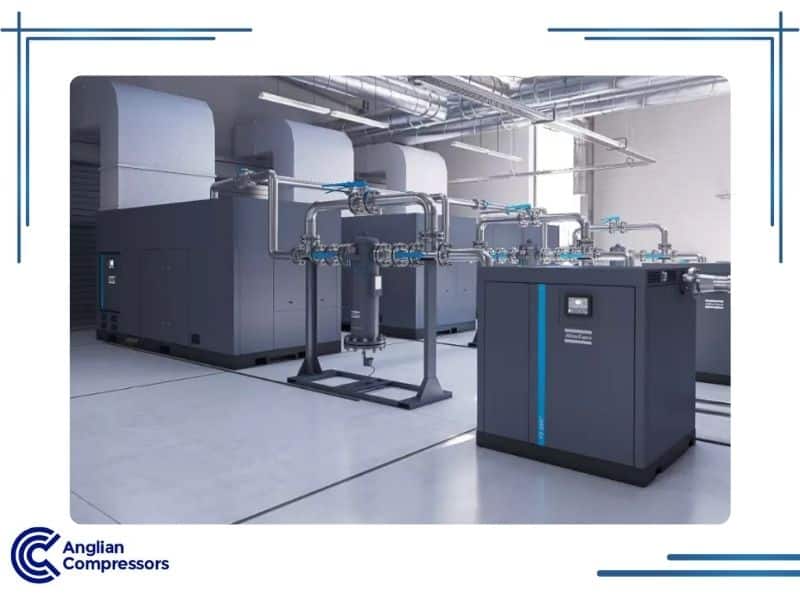
How Do Refrigerated Air Dryers Work?
Refrigerated air dryers work by lowering the temperature of compressed air to +3 °C, the temperature at which water vapor turns into liquid, and then automatically draining away the condensate. This process relies on two interconnected systems: the refrigeration circuit and the compressed air circuit.
The Compressed Air Circuit
The compressed air circuit conducts four major tasks within the dryer:
- Pre-cooling: The cold, dry air exiting the dryer pre-cools the hot, moisture-saturated compressed air as it enters an air-to-air heat exchanger. This reduces the load on the refrigeration system and recycles energy.
- Refrigeration: The pre-cooled air then goes into an evaporator, also known as an air-to-refrigerant heat exchanger, and as the air cools rapidly to the desired +3 °C PDP, the water vapor condenses.
- Moisture Separation: A moisture separator collects the mixture of liquid water and cold air, and an automatic drain valve removes the separated liquid from the system.
- Reheating: As the cold, dry air returns through the air-to-air heat exchanger, it absorbs heat from the incoming air. This prevents condensation on the surface of downstream pipes.
The Refrigeration Circuit
Refrigerated air dryers include a closed-loop refrigeration circuit with an evaporator, compressor, condenser, and expansion valve. This circuit continuously removes heat, keeping the compressed air cool enough for moisture to condense and drain away.
Choosing Your Dryer: Non-Cycling, Cycling, and VSD Technology
The technology controlling your refrigeration system affects its energy use and overall costs:
- Non-Cycling (Fixed Speed) Dryers: These dryers have a refrigeration compressor that runs continuously at full capacity, which makes them the least energy-efficient option with variable demand, even though they have the lowest initial cost. They work best in settings with consistent air demand.
- Cycling Dryers: Cycling dryers turn their refrigeration system on and off based on air demand, and they often store cold energy, allowing them to dry air even while the compressor is off.
- Variable Speed Drive (VSD) Dryers: VSD technology offers the best energy efficiency of the types available. A VSD, or inverter, adjusts the refrigerant compressor motor’s speed to match the cooling energy with real-time air demand, creating a near perfect linear relationship between energy use and air demand. VSD dryers are the most cost-effective choice for businesses focused on sustainability, providing the highest energy savings and lowest overall lifecycle cost, and the Atlas Copco FD VSD series is a great example of this control.
Refrigerated vs. Desiccant Dryers: Which is Right for You?
While refrigerated dryers are the most common solution, some applications require a different approach. The quality of air needed for your process will determine which compressed air dryer is appropriate:
| Dryer Type | Typical PDP | Ideal Use | Energy Use | Maintenance |
| Refrigerated | +3 °C (Class 4) | General industrial use | Moderate | Low |
| Desiccant | -40 °C to -70 °C (Class 1-2) | Critical, high-purity or sub-zero applications | Higher | Medium-High |
Installation and Maintenance Best Practices
The performance of your air dryer hinges on proper installation and ongoing maintenance.
Correct Sizing and Installation
Sizing a dryer correctly is critical. Don’t just align the dryer’s rated capacity with the compressor’s output; the actual capacity depends on the specific conditions of your facility, including pressure, ambient temperature, and inlet temperature. Always size your dryer for the worst-case scenario.
The ideal layout is: Compressor → Wet Air Receiver → Pre-Filter → Dryer.
It’s also highly recommended that you install a three-valve bypass around the dryer to facilitate servicing without disrupting your air supply.
Maintenance and UK Compliance
We recommend scheduling monthly condenser fin cleanings, weekly checks of automatic drains, yearly filter replacements, and an annual professional F-Gas service.
The F-Gas Regulations require regular leak checks for refrigerated dryers in the UK. A certified technician must service the refrigerant circuit, and Anglian Compressors are fully qualified to handle this critical task. Energy-efficient dryers also support the UK Energy Savings Opportunity Scheme (ESOS) and the ISO 50001 energy-management framework.
The Anglian Compressors & Atlas Copco Solution
As specialists in Atlas Copco equipment, we offer you our insight into their range of high-efficiency refrigerated air dryers:
- FX Series: A durable and cost-effective plug-and-play solution.
- FD Series: A high-efficiency series designed for a low total cost of ownership. These models offer optional energy recovery modules that reclaim waste heat.
- FD VSD Series: The best option for businesses prioritised on sustainability and low lifecycle costs.
Case Study:
An Atlas Copco FD 760VSD refrigerated dryer (FD series) was installed in a Manchester food and beverage facility, which achieved a 35% reduction in power consumption and 18 months with zero downtime. This installation, supported by a nearby service crew, demonstrates the tangible energy and reliability benefits these dryers can provide.
Protecting Your Operations
Moisture in a compressed air system leads to equipment corrosion, product contamination, and increased energy costs. A properly sized and maintained industrial air dryer is vital for most UK industrial facilities. Choosing the right technology requires a clear understanding of your air needs and business goals for compressed air treatment.
To learn more or schedule a service, contact our team at Anglian Compressors.