

What Is a Particulate Filter for Compressed Air?
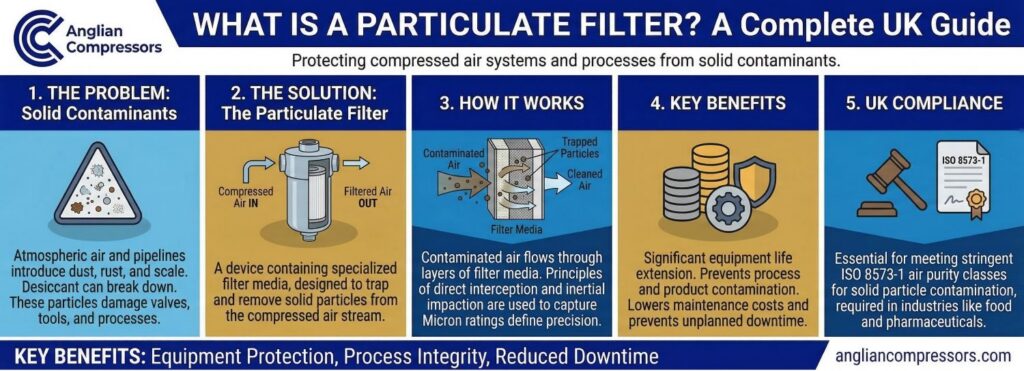
A particulate filter for compressed air is a mechanical device designed to remove solid contaminants such as dust, rust, pipe scale, and metal particles from a compressed air system. Its primary function is to protect downstream equipment, maintain air quality, and support compliance with ISO 8573-1 by preventing abrasive particles from circulating through tools, valves, and production processes.
For industrial operators across East Anglia and the Midlands, Anglian Compressors supplies particulate filtration systems that address both regulatory requirements and long-term operational efficiency, reducing equipment wear, unplanned downtime, and avoidable energy losses.
The Mechanics of Contamination
Contamination in a compressed air system is a function of ambient intake quality and internal system degradation. The compression process significantly increases the density of airborne particulates. When ambient air is compressed to 7 bar, the contaminant concentration increases by a factor of eight per cubic metre.
External Contamination Sources
- Atmospheric Ingestion: Compressors draw in ambient air containing dust, pollen, and hydrocarbon particulates.
- Intake Bypass: Particles smaller than the micron rating of the intake filter (typically >3 microns) pass directly into the compression chamber.
Internal Contamination Sources
- Compressor Wear: The operation of screw rotors and pistons generates metal fines and wear debris.
- Distribution Piping: Ageing pipework, particularly galvanised steel, sheds rust and scale flakes into the airstream.
- Desiccant Breakdown: Adsorption dryers release fine desiccant dust during the tower switching cycles required for regeneration.
How Filtration Works: Physics Mechanisms
High-efficiency filtration relies on four distinct physical mechanisms to capture particles across different size ranges.
- Inertial Impaction: The capture of larger particles that cannot follow the airstream around a fibre.
Particles typically larger than 1 micron possess sufficient momentum to travel in a straight line, colliding with and adhering to the filter media fibres. - Direct Interception: The capture of particles that follow the airstream but pass within one radius of a fibre.
Particles in the 0.1 to 1 micron range are intercepted mechanically when their trajectory brings them into physical contact with the media structure. - Diffusion (Brownian Motion): The capture of ultra-fine particles driven by random molecular collisions.
Particles smaller than 0.1 micron move erratically due to collisions with gas molecules. This increased path length maximises the probability of contact with a filter fibre. - Most Penetrating Particle Size (MPPS): The particle size at which efficiency is lowest.
This typically occurs between 0.3 and 0.6 microns, where neither inertia nor diffusion is dominant. High-performance filters are rated specifically to address this minimum efficiency point.
Dry vs. Wet Filters: Operational Differences
Distinguishing between particulate and coalescing filters is critical for preventing system failure. Each type requires a specific flow orientation to function correctly.
Coalescing Filters (Wet)
- Target: Liquid water and oil aerosols.
- Flow Direction: Inside-to-Outside.
- Function: Air passes through the media, causing aerosols to merge (coalesce) into drops, which drain via gravity to the housing base.
Particulate Filters (Dry)
- Target: Solid particulates (dust, rust, desiccant fines).
- Flow Direction: Outside-to-Inside.
- Function: Air flows from the exterior to the core, utilising the larger surface area of the outer element to maximise dust-holding capacity.
Operational Risk
Reversing the flow direction of a coalescing filter prevents drainage. Liquid accumulates inside the element core until it is re-entrained as a concentrated “slug” of water, which passes downstream to damage pneumatic components.
Equipment Failure Modes
Inadequate particulate filtration leads to specific mechanical failures in industrial equipment.
Pneumatic Valve Stiction
Fine dust combines with oil oxidation byproducts to form a varnish-like sludge. This accumulation increases static friction in directional control valve spools. A standard valve shift time of 20 milliseconds can increase to over 100 milliseconds, causing synchronisation errors in automated production lines.
Equipment Scoring and Wear
Solid contaminants such as rust and desiccant dust act as abrasive grit. When introduced into air tools, cylinders, or air bearings, these particles score sealing surfaces and cylinder walls, resulting in premature air leakage and mechanical failure.
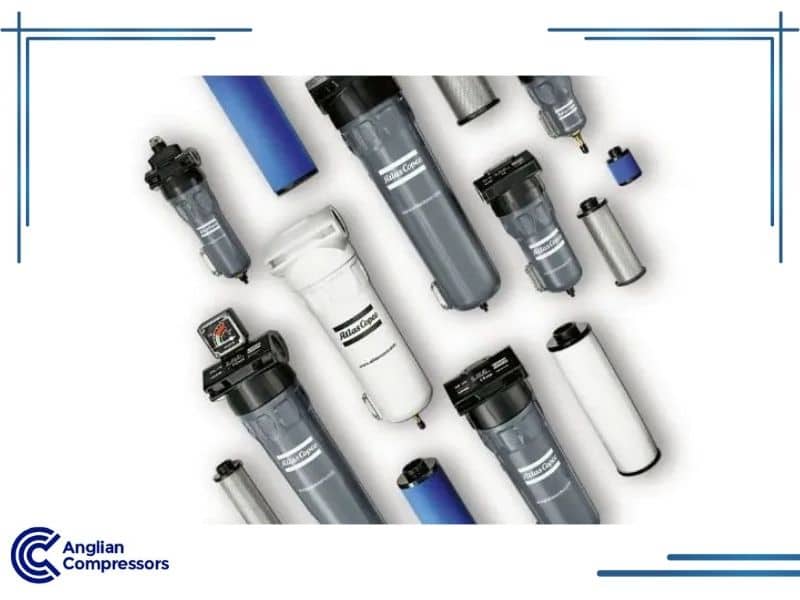
Atlas Copco Filtration Solutions
Anglian Compressors supplies Atlas Copco filtration technology designed to meet specific purity requirements.
- DDp+ Series: A dry particulate filter designed for dust removal down to 1 micron.
- PDp+ Series: A high-efficiency dry particulate filter designed for fine dust removal down to 0.01 micron.
- UD+ Series: A combined filtration solution utilising Nautilus spiral geometry. This design reduces pressure drop by 40% compared to traditional dual-filter trains while maintaining high efficiency.
- InPASS Technology: Advanced housings feature a built-in bypass, allowing element replacement during operation without interrupting airflow.
Installation and Placement Guide
Correct filter placement is determined by the state of the air (wet or dry) at that specific point in the system.
The Wet Zone
Location: Immediately downstream of the compressor and wet receiver.
Requirement: Coalescing filters (DD+/UD+).
Purpose: To remove bulk water and oil aerosols before they reach the dryer.
The Dry Zone
Location: Immediately downstream of adsorption (desiccant) dryers.
Requirement: High-efficiency particulate filters (PDp+).
Purpose: To capture the abrasive desiccant dust generated by the dryer towers before it enters the distribution piping.
The Economics of Pressure Drop
Filter condition directly impacts energy consumption. As contaminants accumulate, the differential pressure across the filter increases, forcing the compressor to consume more power to maintain system pressure.
The Energy Rule: A pressure drop of 1 bar increases energy consumption by approximately 7%.
Allowing a filter to reach saturation results in significant energy waste. Replacing elements based on fixed operational intervals prevents the exponential rise in pressure drop that occurs at the end of the filter’s service life.
Compliance and Regulatory Standards
Filtration specifications must align with the relevant industry standards for safety and quality.
- General Industry (ISO 8573-1:2010): Defines air purity classes. Class 1 particulate air (≤20,000 particles 0.1–0.5 microns per m³) is required for critical applications such as electronics.
- Food & Beverage (BCAS Guideline 102): Mandates specific filtration for air in direct contact with food. This typically requires Class 2:2:1 purity to prevent physical and microbial contamination.
- Medical (HTM 02-01): Requires duplex (parallel) filtration banks for medical gas pipeline systems. This ensures a continuous supply during maintenance or filter failure.
- Safety (PSSR 2000): Classifies filter housings as pressure vessels. They must be included in a Written Scheme of Examination and undergo regular statutory inspection.
Conclusion
Particulate filters provide essential protection against the mechanical wear and process contamination caused by solid debris. Selecting the correct micron rating and ensuring the appropriate flow direction are critical engineering decisions that determine the service life of downstream assets and compliance with quality standards.
To verify that your filtration system meets ISO 8573-1 requirements, contact Anglian Compressors for a system audit or to discuss servicing packages.