

What Is a Coalescing Filter in a Compressed Air System?
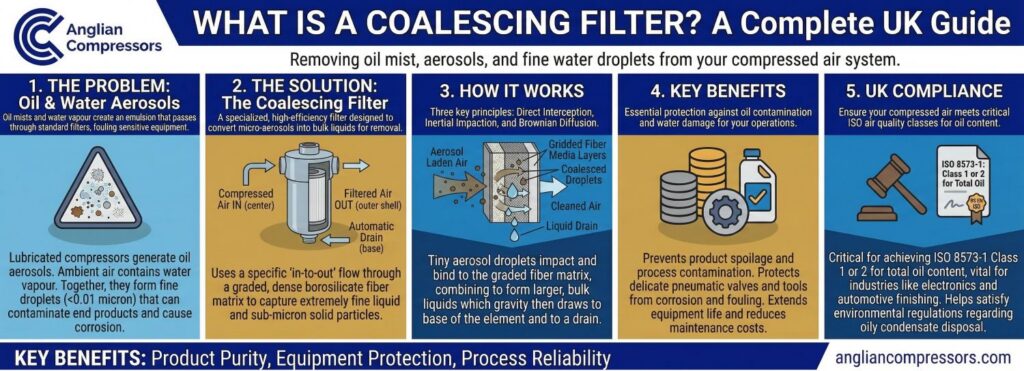
A coalescing filter is a compressed air filtration device that removes liquid oil aerosols, water droplets, and fine particulate contamination from pressurised air. It functions by forcing airflow through a dense fibre medium that merges microscopic liquid droplets into larger condensate, which drains from the system. Coalescing filters are used to meet compressed air purity classifications such as ISO 8573-1 and to protect downstream equipment.
For industrial users supported by Anglian Compressors, correct coalescing filtration reduces equipment wear, protects dryers, and maintains air quality across production environments in East Anglia and the Midlands.
How does a coalescing filter work?
The filter forces air through a thick layer of borosilicate glass fibres. This media traps tiny liquid droplets, which merge into larger drops and drain away via gravity.
The filtration process relies on three specific mechanisms to capture contaminants of different sizes:
- Diffusion: This targets the smallest particles (below 0.1 microns). These particles move randomly due to Brownian motion, increasing the likelihood of collision with the filter fibres.
- Interception: This removes medium-sized particles (between 0.1 and 1 micron). These particles follow the airflow stream but adhere to the fibres when they pass within one particle radius.
- Inertial Impaction: This captures larger particles (above 1 micron). These particles are too heavy to follow the airstream path around the fibre and collide directly with the media.
What is the difference between oil aerosols and oil vapours?
An aerosol is a liquid droplet suspended in air, whereas a vapour is a gas. This phase-state distinction determines which filter is required.
- Oil Aerosols: These are liquid particles ranging from 0.01 to 10 microns. Coalescing filters are designed to remove these fluid contaminants.
- Oil Vapours: These are gaseous molecules smaller than 0.001 microns. Coalescing media cannot capture gas.
Because vapour passes through standard filtration unimpeded, an activated carbon filter is required to remove it. You can read more about the different compressed air filters available for each contaminant type.
Why is a coalescing filter necessary for desiccant dryers?
A coalescing filter acts as a critical protection stage for desiccant dryers. The relationship is defined by a specific failure pathway:
- Pathway: Without effective pre-filtration, liquid oil aerosols enter the dryer vessel.
- Contamination: The oil coats the hygroscopic desiccant beads and blocks their microscopic pores.
- Failure Outcome: The blocked pores prevent moisture adsorption. The dryer fails to reach its required dew point, and the desiccant media suffers permanent damage requiring total replacement.
What are the specifications of Atlas Copco filters?
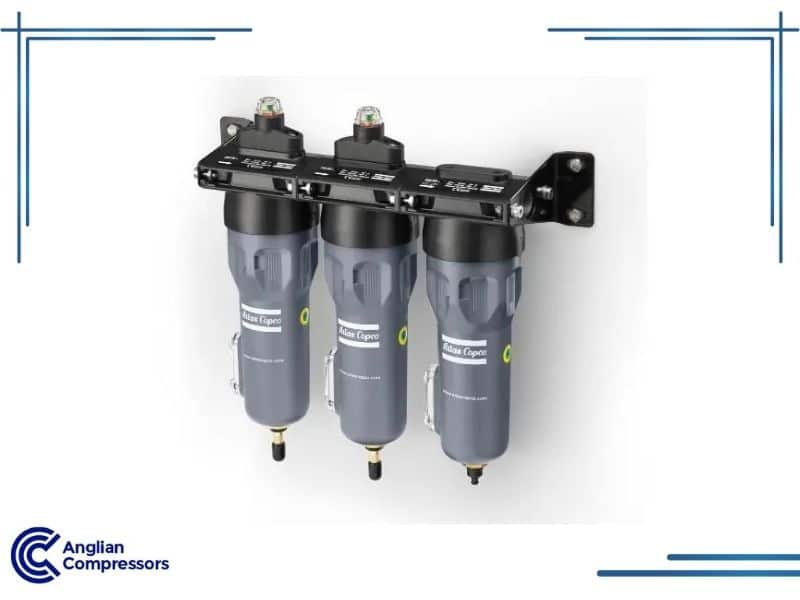
Atlas Copco filters utilise specific engineering attributes to balance high capture efficiency with low energy consumption.
- Media Construction: Borosilicate glass microfibers with oleophobic coatings to prevent liquid saturation.
- Housing Material: Die-cast aluminium or stainless steel options for corrosion resistance.
- Pressure Rating: Standard housings are rated for working pressures up to 16 bar.
- Connectivity: Selected models feature an inPASS bypass head to facilitate cartridge replacement without halting airflow.
- UD+ Series Performance: This range utilises a spiral-wound geometry to combine coarse and fine filtration stages, reducing pressure drop by 40 per cent compared to traditional two-filter stacks.
Where should the filter be installed in the system?
The correct installation sequence is essential for system performance and component longevity.
- Water Separator: Installed first to remove bulk liquid condensate and prevent filter flooding.
- Coalescing Filter: Installed second to remove fine oil mists and protect the dryer.
- Air Dryer: Installed third to remove water vapour from the air stream.
- Dust Filter: Installed fourth to trap abrasive dust particles released by the desiccant dryer.
- Carbon Filter: Installed last to remove remaining hydrocarbon odours or vapours.
How do you size and maintain a coalescing filter?
Correct sizing and maintenance are primary factors in controlling operational costs. Sizing must account for the compressor’s maximum airflow with appropriate correction factors applied. Undersizing leads to high air velocity, which pushes oil back into the distribution pipework.
Maintenance and Energy Efficiency
Filter maintenance directly correlates with energy consumption.
- Replacement Interval: Elements should be replaced annually or every 4,000 to 8,000 hours to maintain structural integrity.
- Pressure Drop Impact: A clogged filter restricts flow. A pressure drop of 1 bar increases compressor energy usage by 7 per cent.
- VSD Compatibility: On variable speed drive compressors, excessive pressure drop negates the intended efficiency gains.
Regular air compressor service ensures these components are monitored and changed before energy penalties occur.
Troubleshooting: The Scavenge Line
Rapid filter saturation is often a symptom of an upstream mechanical fault rather than a filter defect.
- Indicator: A new coalescing element becomes saturated with oil within days of installation.
- Probable Cause: The compressor’s scavenge line, designed to return oil from the separator to the airend, is blocked or malfunctioning.
- Corrective Action: Inspect and clear the scavenge line. Professional leak detection and system audits can assist in diagnosing these mechanical issues.
What industries require coalescing filtration?
High-purity air is a requirement across various sectors, each with specific contamination risks.
- Food and Beverage: Coalescing filtration prevents oil carryover to ensure compliance with hygiene standards.
- Pharmaceuticals: Sterile production environments require the elimination of aerosols to prevent product contamination.
- Electronics: Clean air is necessary to prevent microscopic oil deposits from damaging sensitive circuit boards.
- Paint Shops: Filtration removes silicone and oil mist that causes “fisheye” defects in paint finishes.
Conclusion
A coalescing filter serves as the primary barrier against liquid contamination in a compressed air system. It safeguards downstream dryers and ensures the final air quality meets production requirements. Regular maintenance of these components prevents energy waste and maintains system integrity.
For assistance with sizing, or to request an air compressor energy saving guide, contact Anglian Compressors. We are a local compressor company providing support across the region.