
Understanding PSI in air compressors
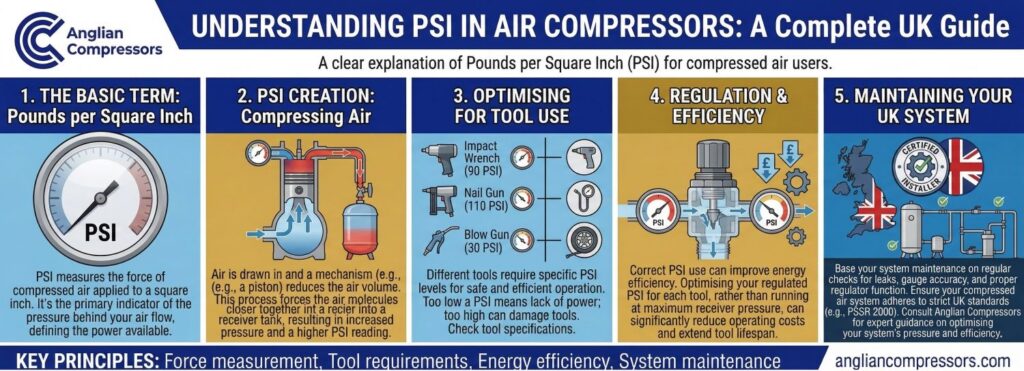
Understanding PSI in air compressors is fundamental to balancing system performance with running costs. Running equipment at incorrect pressure levels often leads to accelerated wear and inflated energy bills. At Anglian Compressors, we help facilities optimise pressure for maximum efficiency using industry-leading technology.
This guide explains the mechanics of PSI, the difference between PSIG and PSIA, and how specific pressure settings impact your total energy consumption.
What Is the Difference Between PSI, PSIA, and PSIG?
The difference lies in the specific reference point used to measure force. PSI (Pounds per Square Inch) is the base unit of pressure. PSIG (Gauge) measures pressure relative to the ambient atmosphere. PSIA (Absolute) combines the gauge reading with local atmospheric pressure to provide a total vacuum-referenced value.
For most facility managers, PSIG is the only metric that matters for daily operations. When you inspect the display on an Atlas Copco GA compressor, the figure shown is always gauge pressure.
This reading ignores the approximately 14.7 PSI of atmospheric pressure that already surrounds the equipment at sea level. We categorise these terms to ensure clarity during system audits:
- PSI: The fundamental imperial unit measuring one pound-force applied to one square inch of area.
- PSIG: The practical reading seen on dials and SMARTLINK monitoring dashboards, starting at zero at atmospheric pressure.
- PSIA: A calculation used for engineering thermodynamics, defined as the gauge pressure plus the atmospheric pressure (PSIG + 14.7).
Confusing these figures can result in inaccurate system specifications. Misreading the pressure baseline often leads to over-pressurisation. This directly increases the electricity bill for your facility.
How Do PSI and CFM Differ in Compressor Performance?
Over-pressurisation often stems from confusing force with volume. PSI (Pounds per Square Inch) measures the static force available to perform work. CFM (Cubic Feet per Minute) measures the quantity of air flowing continuously to sustain that work. High pressure without enough flow causes tools to stall. High flow with low pressure lacks the power to drive them.
You cannot run a high-demand facility effectively without balancing both attributes. Our system design services ensure these metrics are aligned with your specific production requirements.
Manufacturers like Atlas Copco design compressors to balance these outputs. Your specific tools dictate the priority. A heavy-duty 1/2 inch impact wrench needs high PSI to generate torque for a few seconds. An orbital sander demands consistent CFM to maintain rotation without stopping.
Key differences in application:
- PSI: Delivers the “punch” or torque required for clamping, nailing, and fastening.
- CFM: Provides the “stamina” needed for continuous rotary tools like drills and grinders.
Once you understand these distinct roles, you can accurately calculate the total air demand for your specific facility.
Why Does Incorrect PSI Increase Energy Costs?
Incorrect PSI increases energy costs because operating at higher pressure than necessary forces the compressor motor to consume exponentially more electricity to achieve that compression. This excess pressure also creates artificial demand. Unregulated tools and leaks consume significantly more air volume than required by their design specifications.
A widely accepted industry rule states that for every 1 bar (14.5 PSI) of over-pressurisation, your energy consumption rises by around 7%. Since electricity accounts for over 70% of a compressor’s Total Cost of Ownership (TCO) over a ten-year period, this inefficiency is expensive. Running a system at 8 bar when the application only needs 7 bar wastes thousands of pounds annually on power bills.
Artificial demand compounds this issue by pushing more air through leaks and open blowing devices.
- Leak Rate: Higher pressure increases the flow rate through existing leaks.
- Tool Consumption: Unregulated tools use more CFM at higher pressures without increased output.
- Motor Stress: Higher load reduces the lifespan of components like the Atlas Copco GA series air end.
We recommend conducting professional energy audits to identify these pressure imbalances. By using tools like AIRScan, we can pinpoint exactly where pressure can be lowered to reduce costs while maintaining system reliability.
Which Atlas Copco Pressure Ranges Suit Specific Industries?
Selecting the correct pressure range depends entirely on your application’s demand. Atlas Copco offers standard GA rotary screw compressors that operate between 7 and 13 bar for general manufacturing. For specialised sectors, pressure requirements vary significantly to ensure process efficiency and safety.
For industries requiring absolute purity, such as food production or pharmaceuticals, the ZR/ZT oil-free series provides Class 0 certified air without risking contamination. Heavy-duty applications like laser cutting or PET plastic bottling often need much higher forces. Here, we install high-pressure boosters to increase output up to 45 bar locally rather than pressurising the whole network.
Variable Speed Drive (VSD) technology further refines this control. A VSD compressor stabilises system pressure within a narrow band of +/- 0.1 bar. This prevents the energy waste seen in fixed-speed load/unload cycles.
We supply a full range of Atlas Copco compressors designed to meet these specific targets:
| Industry Application | Recommended Series | Typical Pressure Range |
| General Manufacturing | GA Oil-injected Screw | 7 – 13 bar |
| Food & Pharma | ZR/ZT Oil-free | 7 – 10 bar (Class 0) |
| PET Bottling | P High-pressure Booster | Up to 45 bar |
Once the correct pressure hardware is in place, the next challenge is ensuring that pressure isn’t lost through distribution network faults.
What Are the Risks of Pressure Drops and Leaks?
Pressure drops, and leaks force your air compressor to operate at a higher setpoint to compensate for restricted flow at the point of use. This inefficiency increases energy consumption by around 7% for every 1 bar of excess pressure generated to overcome the loss. We define this as artificial demand. The machine generates air solely to feed leaks rather than production.
We often identify the “Dirty Thirty” as the last 30 feet (9 metres) of distribution piping.
This section is frequently the primary source of flow restriction. Traditional galvanised steel pipes suffer from internal corrosion that narrows the pipe diameter and disrupts laminar flow. AIRnet aluminium piping prevents this issue by maintaining a smooth, corrosion-free inner surface that minimises friction.
The financial and running risks of ignoring these network faults include:
- Inflated energy bills from the compressor working harder to maintain system pressure.
- Premature wear on the compressor element due to increased duty cycles.
- Inconsistent torque on pneumatic tools leads to quality control failures.
Identifying these losses needs a structured approach to auditing the entire air network.
How Does PSSR 2000 Affect Your PSI Compliance?
The Pressure Systems Safety Regulations 2000 (PSSR) affect your compliance by legally mandating a Written Scheme of Examination (WSE) for any system operating above 0.5 bar. This regulation ensures your equipment remains within safe pressure limits to prevent catastrophic failure. Safety margins must be proven through documented audits.
The critical metric for compliance is the 250 bar-litres threshold. This figure is calculated by multiplying the internal volume of your pressure vessel in litres by its maximum working pressure in bar. If your system exceeds this value, you are legally required to have a certified WSE in place.
Most industrial setups easily surpass this limit. A standard 200-litre receiver running at 7 bar equals 1400 bar-litres. This is well above the exemption line set by the Health and Safety Executive (HSE).
Anglian Compressors acts as the Competent Person to manage this complex requirement. We ensure your system meets strict safety standards through:
- Identification of all pressure vessels and safety devices.
- Calculation of safe operating limits and inspection intervals.
- Creation of a certified WSE document for your records.
Once your safety framework is established and compliant, you can safely focus on adjusting pressure settings for maximum efficiency.
Correct PSI settings are critical for managing cost, safety, and performance. As the leading experts in the East of England, our team helps you achieve the perfect balance for your facility.
Contact Anglian Compressors today to schedule an AIRScan audit and ensure your system is operating at the precise pressure you need.