

Troubleshooting Low Pressure in Your Air Compressor
Low pressure in an air compressor system is a functional fault that directly affects productivity, tool performance, and operational reliability. The cause is rarely isolated to the compressor itself and more often arises from an imbalance between air supply and site demand, compounded by leaks, restrictions, or component degradation elsewhere in the system.
This article explains how to diagnose low pressure methodically, separating supply-side faults from demand-side losses, and outlines corrective actions. The guidance reflects the service and diagnostic approach used by Anglian Compressors when restoring industrial compressed air systems to stable operating pressure.
Is It a Supply Issue or a Demand Issue?
Low pressure results from a fundamental imbalance: either Supply (generation) is insufficient, or Demand (consumption) is excessive. The isolation test definitively separates these variables.
Close the isolation valve between the compressor receiver and the plant distribution main, then start the unit.
- If pressure builds to the cut-out setpoint, The compressor is mechanically sound. The fault lies downstream in the distribution network (leaks or excess demand).
- If pressure fails to build: The fault is internal to the compressor package.
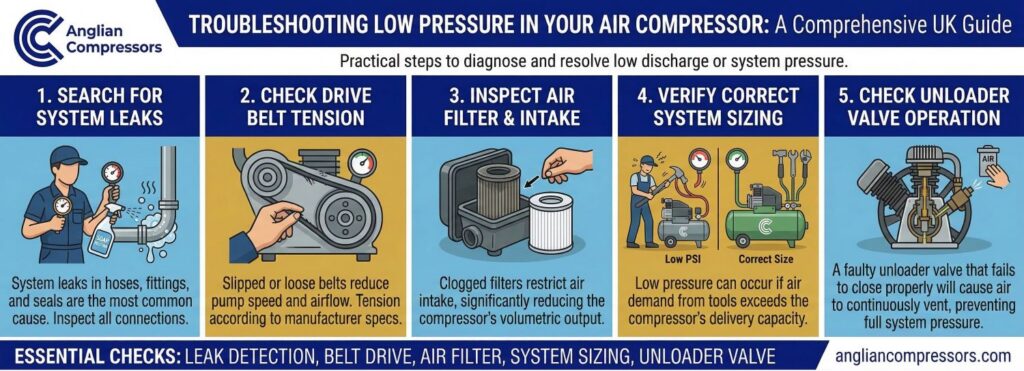
Common Compressor Faults (Supply-Side)
If the isolation test indicates a supply-side failure, specific mechanical or electrical restrictions are preventing the compressor from generating its rated flow.
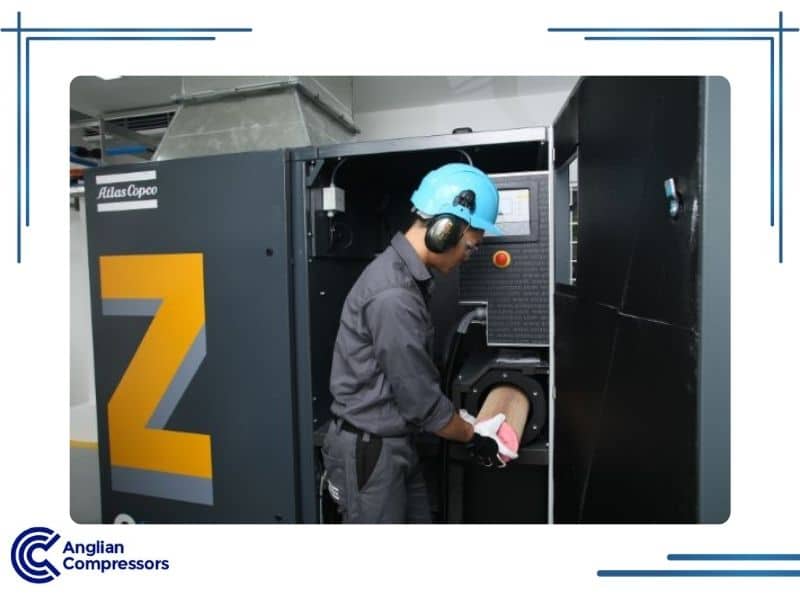
Restricted Inlet Filters
The air intake filter removes particulate matter from the ambient air. Heavy contamination restricts the volumetric intake, forcing the compressor to operate at a higher pressure ratio for reduced output. Routine inspection of the differential pressure across the intake prevents this volumetric deficiency. Regular checks as part of a compressed air maintenance checklist are essential.
Inlet Valve and Solenoid Failures
The inlet valve modulates air entry into the compression element. Electrical failure of the control solenoid or mechanical seizure of the valve due to varnish prevents the valve from opening.
In this state, the motor operates, but the airend pulls against a partial vacuum instead of drawing in fresh air. A distinct change in operating noise, typically a high-pitched whine, often indicates this starvation state.
Blocked Separators and Filters
The oil separator element removes oil mist from the compressed air stream. Saturation or particulate clogging increases the differential pressure (pressure drop) across the element.
This creates a disparity where the airend generates the required pressure, but the discharge pressure is significantly lower. Monitoring differential pressure across these filters is a key component of air compressor service and repair.
Oil and Temperature Issues
Oil in a rotary screw compressor seals the clearance between rotors. Excessive operating temperatures reduce oil viscosity, compromising this seal.
Lower viscosity reduces the oil sealing film, increasing internal slip (blow-by), reducing the delivered free air delivery (FAD). Functional cooling systems are critical for maintaining viscosity and volumetric efficiency.
System Issues (Demand-Side)
If the compressor functions correctly during isolation, the issue lies within the distribution infrastructure. This indicates that air is being lost or restricted before reaching point-of-use applications.
Air Leaks
Air leaks represent the most significant source of pressure loss in UK industrial systems. Unmanaged networks typically lose 20% to 30% of generated air to leakage.
A single 3mm orifice at 7 bar wastes approximately £2,200 annually. Since many leaks are inaudible in production environments, professional leak detection for air compressors using ultrasonic equipment is required to quantify and locate these losses.
Pipework: Corrosion and Friction
Legacy galvanised steel pipework is susceptible to internal corrosion. This increases surface roughness, generating friction that causes a pressure drop between the compressor and the point of use.
Upgrading to smooth-bore aluminium systems helps restore laminar flow. Consultation on compressed air pipework is recommended to determine if corrosion is a limiting factor.
Pipework: Capacity Mismatch
Adding machinery without resizing infrastructure creates velocity bottlenecks. Undersized piping forces air to travel at excessive velocities, resulting in significant turbulence and pressure loss.
Artificial Demand
Increasing the compressor setpoint to compensate for low pressure creates “artificial demand.” Higher system pressure increases the mass flow rate through all leaks and unregulated applications, compounding energy waste without resolving the underlying deficit.
The correct corrective action involves reducing pressure drop in compressed air systems by fixing leaks and removing restrictions.
Electrical and Sensor Faults
Modern units, such as the Atlas Copco GA series, utilise pressure transducers for control logic. Sensor drift can cause the controller to read a falsely high pressure (e.g., 7 bar) while the actual pressure is low (e.g., 4 bar), triggering premature unloading.
Conversely, if control logic is sound, the issue may be a capacity deficit where the compressor is simply undersized for the current load profile. In variable demand scenarios, a variable speed drive (VSD) air compressor may improve supply matching.
Safety and Compliance
Troubleshooting high-pressure systems falls under the Pressure Systems Safety Regulations 2000 (PSSR). Safety devices, particularly relief valves, must never be adjusted to compensate for system pressure issues.
All inspections and interventions must be conducted by a competent person to ensure regulatory compliance and operational safety.
Conclusion
Low pressure typically indicates specific mechanical faults or system inefficiencies rather than total equipment failure. A systematic diagnosis, isolating the supply side from the demand side, allows operators to identify blocked filtration, mechanical restriction, or distribution leakage as the root cause.
For persistent pressure issues, professional intervention is required. Contact the team at Anglian Compressors for expert advice, breakdown support, or to book a comprehensive system audit.