

Rotary vs Piston Air Compressors Explained
Learning about the different types of air compressors helps you decide if your facility needs constant pressure or intermittent bursts of power. Selecting the incorrect mechanism often results in wasted energy and frequent mechanical failures.
As a premier distributor for Atlas Copco, the engineers at Anglian Compressors have spent over 40 years specifying the correct equipment for UK manufacturers. This guide compares the duty cycle, noise levels, and total cost of ownership for each type.
How Do Piston and Rotary Working Principles Differ?
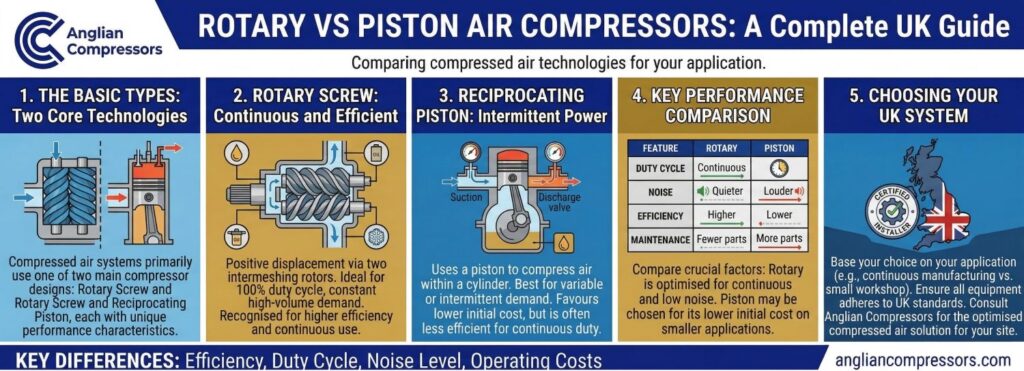
Piston compressors compress air using a reciprocating crankshaft mechanism that drives pistons up and down, while rotary screw systems use two meshing helical screws to force air through a shrinking chamber. This mechanical distinction means pistons deliver air in pulses, whereas rotary screws provide a smooth, continuous stream.
Piston (Reciprocating) Mechanics
In a standard reciprocating compressor, a crankshaft moves a piston within a cylinder. On the downstroke, an intake valve opens to draw air in. On the upstroke, the valve closes to compress the air.
This linear motion generates friction and heat, typically limiting these units to a 60% duty cycle. The resulting airflow pulses require a large receiver tank to stabilise pressure. For workshops with intermittent demand, we supply piston compressors as a cost-effective choice.
Rotary Screw Mechanics
Rotary screw compressors operate by trapping air between two counter-rotating rotors (male and female). As the screws turn, the space between the threads decreases, compressing the air continuously without valves. Oil injection seals internal clearances and removes compression heat, enabling 100% continuous operation.
Key Mechanical Differences
- Motion Type: Pistons use linear reciprocating motion. Screws use continuous rotary motion.
- Air Delivery: Pistons create pulsing air delivery. Rotary screws produce a steady flow.
- Vibration: The Atlas Copco LE series – a range of industrial piston units – generates more vibration than the balanced Atlas Copco GA series rotary screw units.
These mechanical differences directly influence the operational limits discussed next.
Why Does Duty Cycle Matter for Industrial Operations?
Duty cycle is the percentage of a given period during which a compressor can safely operate at full load without overheating. This metric dictates whether your equipment can support constant production lines or only intermittent workshop tasks. Ignoring duty cycle ratings inevitably leads to seized pistons, valve failure, and unplanned downtime.
Reciprocating piston compressors struggle with heat dissipation. Friction from the crankshaft mechanism and piston rings generates high temperatures that require frequent cooling intervals.
It is actually quite frustrating how often we see workshops trying to run these nonstop and then wondering why the unit has failed. Most industrial piston units are limited to a 60% to 70% duty cycle. If your facility demands air for 45 minutes, a piston compressor must rest for the remaining 15 minutes of that hour.
Rotary screw compressors function differently. Models like the Atlas Copco GA series – a leading range of oil-injected industrial screws – use fluid to cool the compression element continuously. This design allows for a 100% continuous duty cycle, meaning the machine can run 24 hours a day without stopping. We can audit your current runtime to confirm if a continuous duty cycle is necessary for your operations.
Consequences of ignoring duty cycle:
- Oversizing: You must buy a piston compressor twice the required size to force the necessary idle time.
- Space Inefficiency: A larger air receiver tank and pump footprint consume valuable floor space.
- Component Fatigue: Running a 60% duty machine at 100% destroys internal seals rapidly.
While duty cycle dictates run time, the actual cost of running these machines depends heavily on how they manage power consumption.
How Can VSD Technology Reduce Total Cost of Ownership?
VSD technology reduces the total cost of ownership by automatically adjusting the compressor’s motor speed to match your facility’s fluctuating air demand, thereby eliminating the energy wasted during unloaded running cycles.
Unlike fixed-speed machines that consume power even when not producing air, a Variable Speed Drive (VSD) ensures the motor only works as hard as necessary to maintain system pressure. This direct correlation between production and consumption prevents the costly “idling” that inflates utility bills.
Most industrial buyers underestimate how heavily electricity dominates the financial picture. Over a typical 10-year service life, the initial buy price is just 10% of the total cost. Energy consumption accounts for around 80% of the lifecycle expense, making efficiency the single biggest factor in your bottom line.
A standard fixed-speed compressor runs at full RPM until pressure is reached, then shifts to an “unloaded” state. While unloaded, the machine produces zero air but still draws roughly 20% of full power.
Atlas Copco – one of the world’s leading providers of sustainable productivity solutions – addresses this inefficiency with its GA VSDˢ technology. These units can reduce energy consumption by up to 60% compared to fixed-speed alternatives by following your demand profile precisely.
To verify if this technology suits your operations, Anglian Compressors performs data-logging using iiTrak energy auditors. We analyse your current usage to project exact savings before you commit to a buy.
The Financial Impact of VSD Technology:
- Eliminates Idling: Stops the motor during low demand rather than running unloaded.
- Stabilises Pressure: Maintains a tight pressure band (within 0.1 bar), reducing artificial demand and leaks.
- Lowers Peak Currents: Soft starting reduces peak electricity demand charges from your utility provider.
Once energy costs are under control, you must consider the physical impact of the machine on your working environment.
How Do Noise, Heat, and Vibration Affect Installation?
Noise, heat, and vibration determine whether a compressor can sit directly on the production floor or needs a separate, soundproofed plant room. Piston compressors generate high decibel levels and physical forces that demand isolation, whereas rotary screw systems operate quietly enough for point-of-use installation.
A standard piston unit creates a loud, hammering sound due to the reciprocating crankshaft mechanism. This mechanical action transmits vibration through the floor. We have known units to slowly walk across the room if not bolted down securely.
In contrast, an Atlas Copco GA series rotary screw compressor uses twin rotor elements that spin continuously. These units typically produce a low-frequency hum between 63 and 70 dB(A). Our installation team can position these quiet units directly on the shop floor to reduce pipework costs.
Because rotary units are virtually vibration-free and handle heat rejection efficiently through oil injection cooling, you can install them right next to your equipment. This “point-of-use” setup reduces pressure drops and eliminates long runs of expensive pipework.
| Feature | Piston Compressor | Rotary Screw Compressor |
| Noise Level | High (75-85+ dB) | Low (60-70 dB) |
| Vibration | High (Needs bolting) | Negligible (Free-standing) |
| Location | Separate plant room | Shop floor (Point-of-Use) |
Physical placement is important, but long-term reliability depends heavily on the servicing schedule.
What Are the Maintenance Requirements and Lifespan?
Piston compressors typically offer a service life of 10,000 to 15,000 hours before requiring a major overhaul due to high internal friction. Rotary screw compressors are designed for longevity, often exceeding 40,000 to 60,000 hours of operation with extended service intervals. This makes rotary systems the standard for continuous industrial applications where downtime is costly.
The reciprocating action in piston units generates heat that degrades valves, belts, and rings rapidly, resulting in frequent maintenance and repair requirements. This mechanical wear often leads to increased oil carryover, which can contaminate downstream equipment if filtration is not managed strictly. Rotary units use oil injection cooling to prevent metal-to-metal contact between the rotors, significantly reducing mechanical wear and extending the time between services.
Compliance is mandatory regardless of the machine type you choose. All commercial systems operating above 0.5 bar generally need a Written Scheme of Examination under the Pressure Systems Safety Regulations (PSSR 2000). Our Peterborough-based engineering team manages these statutory inspections alongside routine service and maintenance schedules to keep your site legal and safe.
Key Service Differences:
- Piston Maintenance: Requires frequent valve and belt checks every 500 to 1,000 hours.
- Rotary Maintenance: Long service intervals of 4,000 to 8,000 hours for oil and filter changes.
- Support: We provide 24/7 breakdown cover and use genuine parts for Atlas Copco – a world-leading manufacturer of compressed air solutions.
Service costs are just one part of the equation when matching a compressor to your specific industry needs.
Which Compressor Type Suits Your Specific Application?
Selecting the right unit depends entirely on your running duty cycle and air volume requirements. Piston compressors suit intermittent, low-demand tasks, while rotary screw systems handle the continuous 100% duty cycle found in manufacturing. Matching the technology to your specific usage pattern prevents premature failure and energy waste.
Piston compressors, such as the Atlas Copco LE/LT series – a range of industrial reciprocating units – operate best when running 50% to 60% of the time. They are ideal for small workshops or East Midlands logistics hubs requiring intermittent tyre inflation.
The reciprocating motion creates heat and vibration, so these units need cooling periods to avoid seizing. We can assess your usage patterns to determine if this intermittent operation fits your needs.
In contrast, rotary screw compressors use twin rotors to produce a steady air stream with low vibration. These units support continuous production lines in automotive paint shops or food processing plants requiring Class 0 oil-free air conforming to ISO 8573-1. Their ability to run 24/7 makes them the standard industrial air compressor system for large facilities.
Comparison of Compressor Applications:
| Feature | Piston Compressor | Rotary Screw Compressor |
| Duty Cycle | 50% – 60% (Intermittent) | 100% (Continuous) |
| Noise Level | High (75 – 85 dB) | Low (65 – 75 dB) |
| Best For | DIY, Garages, Small Tools | Food, Pharma, Manufacturing |
With the application defined, our team is ready to help you finalise the specification.
While piston compressors are ideal for low-cost intermittent use, rotary screw units drive efficiency for continuous demand. We act as consultants to guide your decision rather than just sellers.
Contact Anglian Compressors today to arrange a free site survey or energy audit with our Peterborough-based team.