

Oil in Compressed Air Lines: Causes, Risks & Solutions
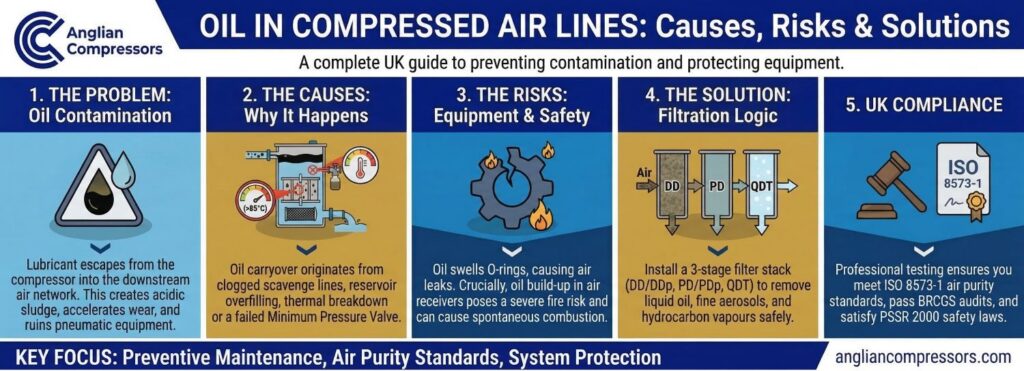
Oil contamination in compressed air systems occurs when lubricant escapes from a lubricated compressor into the downstream air network. This fault increases operating costs, accelerates equipment wear, and creates compliance risks where air quality is regulated. Effective control depends on understanding the mechanical causes of oil carryover and applying the correct prevention or removal strategy.
This article explains why oil enters compressed air lines, outlines the operational and legal risks under UK standards, and sets out proven technical solutions. It also references monitoring, filtration, and oil-free alternatives used by Anglian Compressors to help system owners maintain safe and compliant air supplies.
What causes oil to enter compressed air lines?
All oil carryover originates from separator inefficiency or abnormal operating conditions. In a lubricated rotary screw compressor, oil seals rotors and absorbs heat. A working system must remove this oil before the air leaves the unit.
The five primary causes of oil carryover include:
- Separator element failure: Saturated or ruptured media stops the oil from coalescing, allowing lubricant to pass into the discharge line.
- Clogged scavenge lines: Blocked return lines or stuck check valves prevent oil return to the intake, causing oil to accumulate and enter the air stream.
- Oil reservoir overfilling: Excessive lubricant levels reduce the space available for primary separation, which causes bulk oil to be sucked into the discharge port.
- Thermal viscosity breakdown: Operating temperatures above 85–95°C make the oil too thin, creating a fine mist that bypasses filter media.
- Minimum Pressure Valve (MPV) failure: A malfunctioning MPV allows air to move too fast through the separator, pulling oil into the air lines through sheer velocity.
Maintenance teams use Atlas Copco SMARTLINK, a condition-monitoring platform, to track these issues. The platform identifies rising temperatures or pressure changes before oil reaches the tools.
What are the risks of oil contamination?
Oil contamination leads to three primary outcomes: mechanical damage, energy loss, and product rejection. It creates practical problems for site engineers and facility managers.
How does oil damage equipment?
Oil damages seals, valves, and pipework. It makes O-rings in pneumatic cylinders swell or harden. This leads to air leaks and slow valve response. Oil also mixes with moisture to create acidic sludge. This sludge creates a high pressure drop across the system. The compressor must run longer and use more energy to compensate for this resistance.
What are the industry-specific product risks?
In automotive plants, oil aerosols cause “fisheyes” in paint by disrupting the surface tension of the coating. This prevents the paint from sticking to the surface. Fixing these defects requires stripping the paint back to the bare metal. In food and beverage sites, oil provides a substrate for microbial growth in the pipes. This leads to contaminated batches and product recalls.
What is the user’s responsibility under UK law?
Under the Pressure Systems Safety Regulations 2000 (PSSR 2000), the system user is responsible for keeping the equipment safe. Oil buildup in air receivers is a fire risk. It can cause spontaneous combustion inside the pressure vessel. Food manufacturers also face risks during BRCGS audits. If air contacts food or medicine, filtration alone might not be enough to control the risk.
How can you remove oil from compressed air?
To remove oil, you must use the correct filter stack or change the compressor technology. Filters mitigate oil but do not eliminate the upstream risk of a compressor fault.
What is the correct filtration logic?
A standard filter system uses three stages:
- DD/DDp coalescing filters: These remove liquid oil and large aerosols.
- PD/PDp filters: These catch fine particles and smaller oil drops.
- QDT activated carbon filters: These remove hydrocarbon vapours and smells.
When should you use oil-free technology?
The most reliable solution is to remove oil from the start as a risk-elimination measure. Atlas Copco ZR and ZT series compressors are ISO 8573-1 Class 0 certified. These units do not use oil in the compression chamber. This removes the risk of a blowout entirely. You can read more about the difference between oil-free and oil-lubricated compressors to see which technology suits your site requirements.
Monitoring and professional remediation
Finding oil early prevents production shutdowns. Engineers should check for visible oil at drain points or tool exhausts. Professional testing is the only way to confirm you meet ISO 8573-1 air purity standards.
If a major oil leak happens, the system needs a full clean:
- Drain and clean the contaminated oil reservoir.
- Replace all internal separators and all external filter elements.
- Flush out the distribution lines at every low point.
- Ensure you are managing oily condensate compliant with UK law using oil-water separators.
Maintenance checklist for oil prevention
| Action Item | Frequency | What to Look For |
| Check oil level | 24 Hours | Ensure level is between min/max marks |
| Inspect scavenge line | 2,000 Hours | Check that the line feels warm to confirm flow |
| Replace separator | 8,000 Hours | Watch for a high pressure drop alarm |
| Monitor SMARTLINK | 168 Hours | Look for rising discharge temperature trends |
| Air leak audit | 4,380 Hours | Find leaks caused by degraded seals |
Proper maintenance stops oil from becoming a liability. Checking the scavenge line and keeping temperatures low keeps the air clean. This ensures the system provides the power needed for production without the cost of contamination.
Would you like to verify your air system compliance?
Anglian Compressors provides air quality testing and AIRScan audits to validate ISO purity classes and identify filtration requirements. Contact us now.