

How to Maintain and Replace Compressor Belts: A Technical Guide for UK Industry
The drive belt is often the most undervalued wear part in a belt-driven compressor. Proper maintenance and timely replacement of compressor belts are crucial. Neglecting these tasks can be the difference between a quick, planned 30-minute fix and an unexpected air end seizure, which could halt production for days.
Anglian Compressors (a Branch of Atlas Copco Compressors) has been an Atlas Copco Premier Distributor for nearly 50 years, with manufacturer-trained engineers holding Competent Person status under PSSR 2000.
This guide covers inspection, safety compliance, replacement procedure, tensioning, and OEM parts selection for Atlas Copco GX and GA series compressors.
Why Compressor Belts Are the Cornerstone of Drive Train Reliability
The compressor belt is the critical mechanical interface between the motor and the airend. Its condition determines whether your compressed air system delivers its rated output. So compressed air is often called the fourth utility, alongside water, electricity, and gas.
The Role of the V-Belt in Power Transmission
The V-belt’s trapezoidal cross-section wedges into a sheave groove machined at 34 to 38 degrees (Gates Belt Engineering Guide), generating a normal force on the belt flanks that far exceeds the applied radial tensioning load. Creep is a natural, unavoidable elastic micro-movement as the belt transitions from the tight to the slack side. Slip is gross relative motion that generates heat, glazes sidewalls, and causes rapid failure.
The only slip is a problem, but only instrumentation reliably distinguishes the two.
Belt-Driven vs Direct-Drive: Why the Distinction Matters for Maintenance
The GX 7, GX 11, GA 11, and GA 15 use belt drives to gear standard 2-pole or 4-pole motors running at 2,900 or 1,475 RPM (50 Hz) to the optimal screw element tip speed. The belt also acts as a mechanical fuse: in an air-end seizure, it slips or snaps, potentially saving the motor from burnout. Readers wanting a mechanical background on belt-driven compressors will find further context there.
As a V-belt wears narrower, it rides lower in the sheave groove, changing the effective pitch diameter. The motor draws near-nominal current, so every electrical metric looks normal, but Free Air Delivery (FAD) drops measurably because the screw element is rotating below design speed.
Our engineers across Cambridgeshire, Lincolnshire, and Northamptonshire catch this during 500-hour inspections before it becomes an energy audit problem.
Compressor Belt Inspection: What to Look For and How Often
Visual belt inspection should occur every 500 hours for tension, tracking, and physical condition per Atlas Copco service guidelines. Weekly checks should sit within a broader air compressor maintenance checklist, catching problems at the chirp stage rather than the snap stage.
Our 500-hour inspection service, carried out by manufacturer-trained engineers across Cambridgeshire, Lincolnshire, and Northamptonshire, includes a documented belt condition report.
Visual Signs of Belt Wear and Imminent Failure
Six failure indicators matter. Glazing, shiny, hardened sidewalls, show slippage and heat hardening. Transverse cracking on the belt underside signals heat ageing or a pulley below the minimum bend radius.
Cover fabric separation or visible tensile cords means imminent failure. Profile collapse (belt bottoming out in the groove) destroys the wedging effect entirely. Concave sidewall wear points to misalignment or abrasive dust.
Spin burn, one melted section, shows a stalled airend. Also, inspect the belt guard interior for black rubber dust or rub marks. This shows previous belt flopping or misalignment.
Auditory Diagnostics: What Different Noises Tell You
Chirping at startup is a slip-stick phenomenon, worsened by UK humidity on cold mornings. Continuous squealing under load shows gross slippage. A slapping or rhythmic sound means a loose belt or a missing chunk; shut down immediately.
If a belt has already glazed, tightening it won’t restore grip. Over-tensioning a glazed belt imposes excessive radial load on the airend and motor bearings. Bearing replacement on a GA 11 airend can cost £3,000 to £10,000 (Atlas Copco service documentation), compared to a replacement belt at £50 to £100.
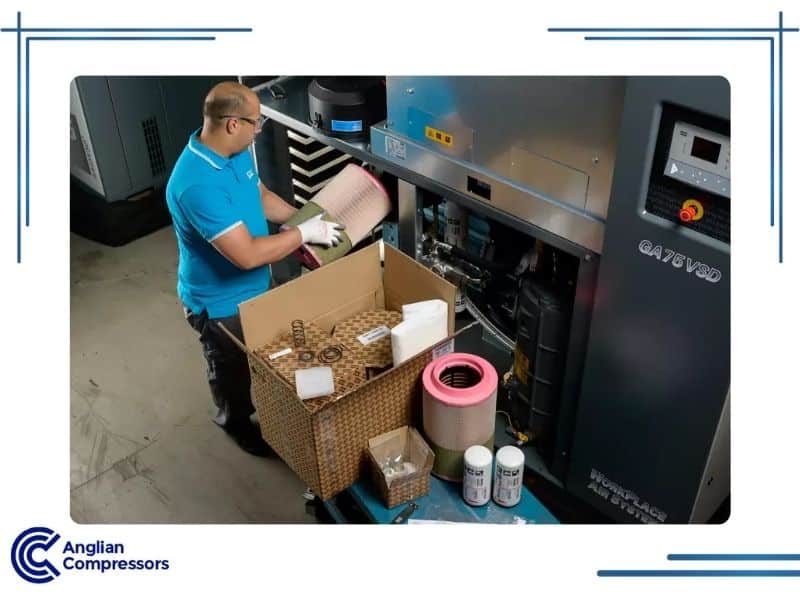
Safety Compliance Before You Touch a Belt: PUWER, PSSR, and Lockout/Tagout
Removing a belt guard is a high-risk maintenance activity under UK law. Both mechanical and electrical hazards need formal control before any work begins.
Legal Obligations Under PUWER 1998 and PSSR 2000
The Provision and Use of Work Equipment Regulations 1998 (PUWER) requires a Point of Work Risk Assessment before any task involving the removal of fixed guards. The Pressure Systems Safety Regulations 2000 apply to the system the belt drives: compressed air systems above 0.5 bar typically need a Written Scheme of Examination (WSE). If improper tensioning causes an airend seizure and pressure release, both the individual and employer’s competency face legal scrutiny.
The Correct Isolation Sequence, Including the VSD Capacitor Wait
Perform a controlled stop via the control panel, not the Emergency Stop, which causes vacuum shock to the airend. Open the main circuit breaker, apply a personal padlock, and attach a tag identifying the person, date, and reason. Verify the system pressure gauge reads zero.
For VSD units such as the GA 11 VSD+, a mandatory 10-minute wait is required after mains isolation. The frequency inverter’s capacitor banks retain lethal DC voltage after the mains is cut. A technician who begins work immediately faces a potentially fatal electrocution hazard that generates no audible warning and is not prevented by padlocking the isolator alone.
Verify the dead using a proving unit and voltage indicator before proceeding.
Anglian Compressors carries out every belt replacement within a documented safety framework. Our PSSR Competent Person inspection service includes a documented Point of Work Risk Assessment for every belt replacement visit.
Step-by-Step: How to Replace Compressor Belts on Atlas Copco GX and GA Series
Complete the full isolation sequence before removing any panels. On GX models, remove the front door, internal panel, and top cover, then remove the belt guard and inspect its interior for rubber dust.
Removal, Pulley Inspection, and Belt Selection
Loosen (don’t remove) the four motor mounting bolts. Turn the tensioning bolt to shift the motor towards the airend, reducing centre distance, then remove the belts. Never pry a belt off with a screwdriver; pulley groove damage and finger injury are both real risks.
Use a sheave groove gauge to check for pulley wear. Clean grooves with a non-oil-based solvent such as brake cleaner or acetone, oil on the sheave will ruin a new belt within hours.
Verify that new belts are Atlas Copco OEM matched sets against the service manual part numbers. In multi-belt drives, always replace the complete set. Most technicians assume replacing a single failed belt in a multi-belt drive is acceptable, it’s not.
A new belt is tighter than a stretched used belt. In a 2- or 3-belt drive, the new belt carries the entire load alone and fails within hours from overload.
Installation, Alignment, and Precision Tensioning
Place new belts loosely over pulleys and move the motor back until snug. Before final tensioning, check alignment using a tool such as the SKF TKBA 40 laser alignment tool, attaching it to the pulley grooves, not the face, which is inaccurate due to casting variations. Check for both angular and parallel misalignment.
For tensioning, use the Gates Sonic Tension Meter: input the belt mass constant, width, and span length, pluck the belt span, and hold the microphone around 10mm away. Match the measured frequency in Hz to the target on the yellow tension sticker inside the cabinet. New belts need around 1.3x the retensioning target frequency to account for initial seating and stretch.
Tighten motor mounting bolts, re-check alignment and tension, rotate the drivetrain by hand to confirm smooth tracking, then replace guards and test run.
Belt Tension Specifications and the 50-Hour Re-Tension Rule
Tension is a Goldilocks problem, and too loose causes slip, heat, and glazing. Too tight destroys airend and motor bearings at a cost of £3,000 to £10,000.
The Sonic Tension Method: Tensioning by Frequency
The belt span behaves as a vibrating string. Tension is a function of mass constant, width, span length, and frequency, eliminating the subjectivity of deflection-based methods. Target frequencies are printed on the yellow sticker inside the compressor cabinet and vary between working pressure variants: 7.5 bar and 10 bar versions have different pulley ratios and so different tension requirements.
Using a generic figure rather than the machine-specific sticker is a common and costly error.
Why the 50-Hour Re-Tension Is Non-Negotiable
New V-belts undergo significant elongation and groove seating during the first hours of operation, a material property of the elastomeric cord pack, not a sign of poor installation. Atlas Copco mandates a re-tension stop after around 50 running hours (or 24 hours of continuous operation). Skip this step, and the belt will slip under peak load, glaze within days, and fail within weeks.
Our service plans include the 50-hour re-tension as a scheduled return visit, not an optional extra.
Preventive Maintenance, OEM Parts, and When to Call a Professional
Belt maintenance sits within a structured preventive maintenance schedule: visual inspection weekly, tension and tracking check every 500 hours, full replacement aligned with 4,000-hour or 8,000-hour service intervals (Service Plan A or B), or earlier in dusty or high-temperature environments.
Building Belt Maintenance Into Your Preventive Maintenance Schedule
Atlas Copco Service Kits for models such as the GA 11 include the belt, air filter, oil filter, and separator element together, preventing a new belt from failing on degraded ancillary components. SMARTLINK remote monitoring tracks temperature, pressure, and running hours in real time.
A drop in FAD or rise in motor temperature can show belt slip before any audible or visual symptom appears, triggering a planned intervention rather than an emergency callout. If a belt does snap, our professional repair services provide rapid response across East Anglia and the Midlands.
The Case for Genuine OEM Compressor Parts and Professional Compressor Services
Generic belts of the correct cross-section and length are not functionally equivalent to genuine Atlas Copco belts. The coefficient of friction and thermal resistance of the rubber compound are not standardised across manufacturers. Under enclosed GA and GX canopy temperatures exceeding 40 to 50°C, a generic belt with lower heat resistance undergoes accelerated cross-linking.
The Arrhenius equation predicts that every 10°C rise in operating temperature doubles the chemical degradation rate of rubber (Parker Hannifin Belt Engineering Reference), halving belt life. Non-OEM parts also void the warranty. EPDM belts, with heat resistance up to 120°C (Gates Belt Engineering Guide), are increasingly specified over Neoprene for enclosed compressor applications.
Anglian Compressors (a Branch of Atlas Copco Compressors) stocks genuine OEM belts, service kits, and compressor parts at our Peterborough warehouse for immediate dispatch.
Right now, without any tools, check your compressor’s running hours display against your last service record. If it reads more than 500 hours since the last belt inspection, the check is overdue.
If your machine has run more than 500 hours since the last belt inspection, that check is already overdue.
Request a belt inspection or service plan quote from Anglian Compressors (a Branch of Atlas Copco Compressors), call our Peterborough team or complete the online service enquiry form.
Frequently Asked Questions
How often should I replace my compressor belt?
Standard replacement aligns with the 4,000-hour or 8,000-hour service interval (Atlas Copco Service Plan A or B). Dusty or hot environments may need earlier replacement. Always replace as a complete OEM matched set, mixing old and new belts in a multi-belt drive causes immediate overload failure of the new belt.
What causes premature compressor belt failure?
Primary causes are incorrect tension, pulley misalignment, worn sheave grooves, oil contamination, and mixing old and new belts. Failure to re-tension after the first 50 running hours is also a frequent culprit. Generic non-OEM belts with insufficient thermal resistance fail prematurely inside enclosed compressors where canopy temperatures exceed 40 to 50°C.
Can I use a non-OEM belt on my Atlas Copco compressor?
Dimensionally equivalent belts exist, but the coefficient of friction and thermal resistance are not standardised across manufacturers. In enclosed GA and GX units, a generic belt will harden and glaze prematurely under canopy temperatures that genuine OEM belts are engineered to withstand. Non-OEM parts also void the warranty.
Why is my compressor making a high-pitched squealing noise?
Continuous squealing shows gross belt slippage under load, generating intense heat that glazes sidewalls rapidly. Check tension first, but if the belt is already glazed, tightening won’t restore grip and replacement is required. Also check for pulley misalignment and oil contamination on sheave grooves.
What is the correct belt tension for an Atlas Copco GX compressor?
Atlas Copco sets out tension by frequency in Hz, printed on the yellow sticker inside the cabinet. The target varies by model and working pressure, so always use the machine-specific sticker rather than a generic figure. Use a Gates Sonic Tension Meter (model 550C). New belts need around 1.3x the retensioning target to account for initial seating and stretch.
What is the 50-hour re-tension rule for compressor belts?
New V-belts stretch and seat into sheave grooves during the first hours of operation. Atlas Copco mandates a re-tension stop after around 50 running hours (or 24 hours continuous). Skipping this results in a loose belt that will slip, glaze, and fail within weeks, often misattributed to the original installation.
Where can I source genuine compressor parts for the Atlas Copco GX and GA series?
Anglian Compressors (a Branch of Atlas Copco Compressors) holds genuine OEM compressor parts, including belts, service kits, filters, and separator elements, in stock at our Peterborough warehouse. Orders placed with our team are available for immediate dispatch or collection, covering GX and GA series models across the UK.