
How Much Does On-Site Nitrogen Generation Actually Cost?
The single biggest misconception about how much nitrogen generation actually costs isn’t the equipment price – it’s the failure to recognise that continuing with bottled or bulk liquid nitrogen is actively costing your business more every single day.
Every invoice you pay includes charges you’ve never scrutinised, and every cryogenic tank you rent loses 10-20% of its contents to boil-off before a single Nm³ reaches your process.
This article breaks down every cost layer – initial investment, energy, maintenance, and UK regulatory compliance – drawing on our experience as an Atlas Copco Premier Distributor (and now a branch of Atlas Copco) since 1977, transitioning UK industrial sites from expensive gas contracts to self-sufficient nitrogen production.
Why Traditional Nitrogen Supply Costs More Than You Think
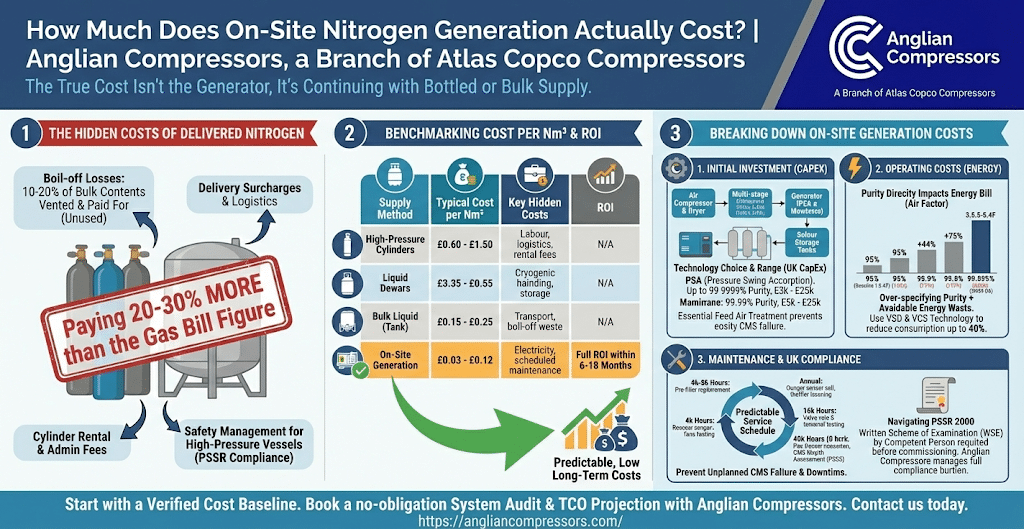
Delivered nitrogen appears straightforward on an invoice, but the invoiced price is rarely the true cost. Once you add delivery surcharges, cylinder rental, procurement administration, and safety management for high-pressure vessels, most businesses are paying 20-30% more than the figure on the gas bill.
Deconstructing Your Current Nitrogen Bill
High-pressure cylinders carry the highest unit cost due to handling and transport inefficiencies. Bulk liquid tanks are cheaper per Nm³, but cryogenic storage introduces boil-off waste and evaporative gas vented to maintain safe internal pressure, representing a 10-20% loss you pay for but never use. So add missed delivery downtime and procurement admin, and the true cost of delivered nitrogen becomes significantly harder to defend.
Benchmarking Delivered vs Generated Costs
| Supply Method | Typical Cost per Nm³ | Key Hidden Costs |
| High-Pressure Cylinders | £0.60 – £1.50 | Labour, logistics, rental fees |
| Liquid Dewars | £0.35 – £0.65 | Cryogenic handling, storage |
| Bulk Liquid (Tank) | £0.15 – £0.25 | Transport, boil-off waste |
| On-Site Generation | £0.03 – £0.12 | Electricity, scheduled maintenance |
On-site generation typically delivers a full Return on Investment within 6 to 18 months, directly countering the CapEx objection most procurement teams raise. Understanding the benefits of on-site generation starts with this cost-per-Nm³ comparison as your baseline.
Our System Audits begin by analysing your existing supply contracts and actual consumption data, giving you a verified cost baseline before we model any investment scenario.
What is the Initial Investment Cost for a Nitrogen Generator?
The generator cost is only one part of the total equipment investment. A complete on-site nitrogen system includes an air compressor, dryer, multi-stage filtration, the generator itself, and buffer storage tanks. Skipping or under-specifying any component creates a far more expensive problem downstream.
Choosing Your Technology: PSA vs Membrane
Pressure Swing Adsorption (PSA) uses dual columns of Carbon Molecular Sieve (CMS) to selectively adsorb oxygen under pressure, delivering purity up to 99.999% – or 99.9999% when paired with an NPH (Nitrogen Purifier through Hydrogen) unit. UK CapEx for standard PSA systems ranges from around £3,000 to £45,000, depending on flow rate.
The Atlas Copco NGP+ series can be supplied as a complete Nitrogen Skid Package, simplifying installation planning. High-capacity units such as the NGP300+ can weigh over 3,600 kg, so a structural assessment is required before installation.
Membrane technology uses hollow polymer fibres to separate nitrogen through selective permeation, suiting moderate purity requirements of 95-99% at around £5,000 to £25,000 for industrial systems. The Atlas Copco NGM series is a practical choice for applications such as tank blanketing or fire suppression, where ultra-high purity isn’t required. For industry-specific investment examples, see our guide to nitrogen for laser cutting.
The Critical Role of Feed Air Treatment
The most common cause of premature generator failure is not enough upstream air treatment. Oil contamination from insufficient filtration will irreversibly poison the CMS beds, collapsing performance and requiring full media replacement within 2-3 years instead of the expected 10-15. Multi-stage filtration must achieve ISO 8573-1:2010 Class 1 for oil content (≤0.01 mg/m³).
Atlas Copco’s inline filter range includes coalescing and activated carbon stages to meet this standard.
Our System Audits specify the right Atlas Copco NGP+ or NGM series generator, along with the correct air treatment, to prevent the costly mistake of under-protecting your capital investment.
How Purity Directly Impacts Your Energy Bill
Electricity is the dominant operating cost in nitrogen production. The purity you specify determines how much electricity you consume – and over-specifying purity is the single largest source of avoidable energy waste in on-site nitrogen generation.
Understanding the ‘Air Factor’ and Energy Penalty
The Air Factor is the volume of compressed air required to produce one volume of nitrogen. It rises sharply with purity, and the relationship is non-linear:
| Purity (%) | Air Factor | Energy Impact vs. 95% |
| 95% | 1.8 | Baseline |
| 99% | 2.3 | +28% |
| 99.5% | 2.6 | +44% |
| 99.9% | 3.1 | +72% |
| 99.999% | 5.3 – 5.5 | ~+200% |
Producing 99.999% pure nitrogen consumes nearly three times the energy of 95% purity. A facility running at an Air Factor of 5.5 when its application only needs 2.6 wastes tens of thousands of pounds annually. Right-sizing purity is the fastest route to reducing operating costs – read more about how gas purity affect cost in practice.
Technology That Reduces Operating Costs
Variable Speed Drive (VSD) compressors, such as the Atlas Copco GA VSD+, match motor speed to real-time air demand rather than running at fixed output. The Variable Cycle Saver (VCS), a standard integrated feature on the Atlas Copco NGP+ series, optimises the PSA adsorption cycle based on demand and ambient temperature, reducing feed air consumption by up to 40% during low-demand periods.
Pairing a GA VSD+ compressor with an NGP+ generator creates a system where energy consumption tracks actual nitrogen demand precisely. The Pressure Systems Safety Regulations 2000 (PSSR) (hse.gov.uk) also apply to these systems, connecting directly to the compliance costs covered below.
What Will You Pay to Maintain and Legally Operate a Nitrogen Generator in the UK?
Maintenance costs for a nitrogen generator are predictable and modest when scheduled correctly. The risk isn’t routine service – it’s the consequence of skipping it.
Predictable Service Costs vs CMS Failure
A standard service schedule runs as follows: pre-filter element replacement at 4,000-8,000 hours. oxygen sensor calibration and exhaust muffler cleaning at the annual service. valve seal and solenoid testing at 16,000 hours.
And a full vessel inspection with CMS health assessment at the 40,000-hour (5-year) major overhaul.
The alternative is unplanned CMS failure. Oil or moisture contamination blocks the precisely engineered pores (3-5 Ångstroms) of the CMS media, causing irreversible capacity loss. A failed CMS bed means unplanned production downtime while replacement media is sourced (typically a 2-4 week lead time) and the cost of reverting to delivered nitrogen supply during that period.
Full CMS replacement is significantly more expensive than the filtration that would have prevented it.
Navigating PSSR 2000 and Other UK Regulations
Nitrogen generators are pressure systems subject to the Pressure Systems Safety Regulations 2000 (PSSR) and apply to any system containing nitrogen at a pressure greater than 0.5 bar above atmospheric. Before commissioning, a Written Scheme of Examination (WSE) must be drawn up by a Competent Person – an individual with enough technical knowledge who is independent of the system’s operational functions.
Failure to maintain a valid WSE exposes directors and managers to personal liability under HSE enforcement, with unlimited fines possible even where no incident has occurred. Systems in potentially explosive atmospheres must also comply with the European ATEX Directive (2014/34/EU).
As a Competent Person under PSSR 2000, Anglian Compressors, a Branch of Atlas Copco Compressors, takes the full compliance burden off your shoulders. Our service plans cover all scheduled maintenance and statutory inspections.
Gather your last 12 months of nitrogen supply invoices, find your true cost per Nm³, and use that number as your starting point. Book a no-obligation system audit with our engineers today – we’ll analyse your current nitrogen costs and provide a detailed TCO projection for an on-site generation system.
Frequently Asked Questions
How much does a nitrogen generator cost?
UK industrial nitrogen generators range from around £3,000 for a small PSA system to over £45,000 for high-capacity units. Final investment depends on required flow rate, purity, and ancillary equipment, including compressors, dryers, and filtration.
What is the cost of 1 litre of nitrogen?
Industrial nitrogen costs are best compared in Nm³, and bulk liquid nitrogen costs £0.15-£0.25 per Nm³. high-pressure cylinders exceed £1.00 per Nm³. On-site generation reduces this to £0.03-£0.12 per Nm³, with the electricity rate as the primary driver.
Are nitrogen generators worth it?
For most industrial users, yes. Removing delivery fees, cylinder rental, and price volatility, an onsite nitrogen generator typically achieves full ROI within 6 to 18 months, then operates as a long-term asset with predictable, low operating costs for 15 or more years.
What is the highest hidden cost in nitrogen generation?
Energy waste from over-specifying purity. The Air Factor rises non-linearly, jumping from 99.5% to 99.999%, more than doubling energy consumption. A purity audit alone can cut production energy costs by 50% or more.
How long does a nitrogen generator last?
The Carbon Molecular Sieve (CMS) lasts 10-15 years with correct feed air quality. Supporting compressors and pressure vessels have comparable service lives, making on-site generation a long-term capital asset with predictable replacement intervals rather than an ongoing supply dependency.