

How Does The Atlas Copco AIRchitect Report Work? A Complete Overview
Compressed air accounts for up to 40% of a plant’s total energy bill, yet most UK facilities have never had their system independently measured, modelled, or benchmarked. How does the Atlas Copco AIRchitect report work? It’s a structured, data-driven audit framework that captures real operational data, models alternative configurations using ISO 1217 performance curves, and delivers a quantified roadmap for reducing energy waste and meeting UK regulatory obligations.
Anglian Compressors, a Branch of Atlas Copco Compressors, is part of the Atlas Copco Group and acts as a Competent Person under PSSR 2000. This article covers every tier of the AIRchitect framework, how the iiTrak device works, what artificial demand costs you, and how audit findings translate into measurable, sustained savings.
The Three-Tier AIRchitect Audit Structure: airCHECK, AIRchitect Survey, and AIRScan Explained
The AIRchitect framework is not a single product. It’s a tiered audit framework with three distinct entry points, each matched to a different operational goal. So choosing the wrong tier is not a minor inconvenience; it can leave a facility without the compliance documentation it legally needs.
Tier 1, airCHECK: The Visual Walkthrough
airCHECK is a non-intrusive visual walkthrough of the compressor room. It identifies immediate quick wins and equipment health issues without disrupting production. It produces a verbal summary, not a compliance document.
Tier 2, AIRchitect Survey: 7–10 Day Data Logging and Simulation
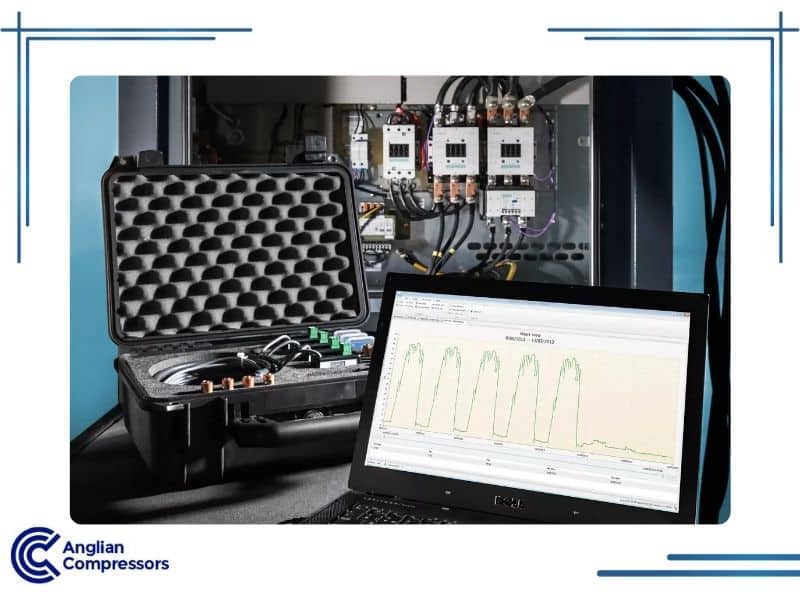
The AIRchitect Survey deploys the iiTrak data-logging device for 7–10 days, capturing a real-world load profile. The output includes load profile graphs, ROI calculations, and payback periods referenced against ISO 1217 Annex C or E performance curves. A professional compressed air audit at this tier is the correct entry point for capital investment decisions.
Tier 3, AIRScan: The Full-Service, ISO 11011-Compliant Audit
AIRScan is compliant with BS EN ISO 11011:2015 and supports ISO 50001 benchmarking. It incorporates ultrasonic leak detection, air quality testing to ISO 8573-1, and vibration analysis. Only Tier 3 generates the investment-grade data set required to substantiate ESOS Phase 3 compliance evidence.
How Does the iiTrak Data-Logging Device Actually Work?
The iiTrak device is the measurement engine behind the AIRchitect Survey. It uses non-intrusive current transformer (CT) sensors clipped onto the incoming electrical supply, no wiring changes, no production interruption.
Current Transformer Sensors and the 7–10 Day Logging Window
CT sensors measure ampere readings continuously. Because current is directly proportional to motor work, iiTrak provides a reliable proxy for air delivery and power consumption across all shifts. The 7–10-day logging window is deliberate: it captures shift rotations, weekend standby, and peak-demand events that a 48-hour log would miss entirely.
Mapping Electrical Data Against ISO 1217 Performance Curves
Once logging is complete, AIRchitect simulation software maps the electrical data against ISO 1217 Annex C or E compressor performance curves to define the AS-IS system status.
Building the AS-IS Load Profile: What the Data Reveals
The software then models TO-BE scenarios, simulating VSD technology or centralised control against the actual load profile to calculate energy savings with mathematical certainty. To monitor air compressor flow on an ongoing basis, flow monitoring complements iiTrak data as a continuous performance check after the audit is complete.
What Is Artificial Demand, and Why Does the AIRchitect Report Quantify It?
Artificial demand is excess compressed air consumption caused by running the system at a higher pressure than the end-use equipment needs. It forces greater air volume through every unregulated orifice and leak, creating demand that serves no production purpose. The Pressure Systems Safety Regulations 2000 (hse.gov.uk) govern the safe operation of these systems, but artificial demand is an efficiency problem that sits entirely outside the maintenance team’s usual line of sight.
How Excess System Pressure Creates Demand That Doesn’t Exist
Artificial demand typically accounts for 10%–15% of total energy consumption in a typical industrial facility. If an auditor fails to account for it before specifying replacement equipment, the new compressor will be oversized for the facility’s actual optimised needs, locking the operator into higher capital expenditure and perpetuating the inefficiency the audit was commissioned to eliminate.
The 7% Rule: Calculating the Financial Case for Pressure Reduction
The AIRchitect report uses the Absolute Pressure Ratio method to quantify artificial demand. Every 1-bar reduction in system discharge pressure delivers around 7% direct energy savings. Reducing pressure by 1 bar also decreases the volume of air lost through existing leaks by around 11%, meaning pressure reduction simultaneously cuts both artificial demand and leak losses.
AIRchitect and UK Regulatory Compliance: PSSR 2000, ESOS, and SECR
PSSR 2000 applies to any compressed air system operating above 0.5 bar above atmospheric pressure – covering virtually every industrial installation in the UK. Understanding what the regulations need and where AIRchitect findings carry legal weight is not optional knowledge for a plant manager.
The 250 Bar-Litres Threshold and Your Written Scheme of Examination
A Written Scheme of Examination (WSE) is mandatory for any system where operating pressure in bar multiplied by receiver volume in litres exceeds 250 bar-litres. A standard 500-litre receiver at 7 bar stores 3,500 bar-litres – well within the regulated zone. The WSE must be drawn up by a Competent Person who is independent from day-to-day system operation.
How AIRchitect Findings Support ESOS and SECR Obligations
Only the Tier 3 AIRScan, compliant with BS EN ISO 11011:2015, generates the energy consumption baseline that both ESOS and SECR annual reporting need. Our AIRScan audit produces WSE-ready documentation and ISO 50001-aligned energy data in a single visit.
From Audit Findings to Action: Leak Detection, RePress Sealing, and the Optimizer 4.0
AIRchitect reports consistently identify leakage as the primary energy waste source. On average, 20%–30% of generated compressed air is lost to leaks. In systems with ageing pipework, that figure can reach 40%.
Ultrasonic Acoustic Imaging: Locating and Costing Hidden Air Leaks
Our ultrasonic leak detection survey uses acoustic imaging cameras equipped with 124 microphones to locate leaks up to ten times faster than traditional methods, even in noisy industrial environments. Each leak is quantified in litres per minute and assigned a specific annual cost and CO2 impact, giving plant managers a prioritised repair list with clear financial justification.
RePress On-Line Leak Sealing: Fixing Leaks Without Shutting Down
RePress seals leaks permanently while the system remains under full operating pressure, using a three-stage protocol: epoxy paste, sealing tape, and fibreglass protective tape. In a 24/7 facility, a single unrepaired 3mm leak at 7 bar can cost thousands of pounds annually. Every week of delay extends the payback period the AIRchitect report calculated.
Optimizer 4.0: Centralised Control as an AIRchitect Recommendation
Where multiple compressors are running inefficiently in sequence, the Optimizer 4.0 is a frequent AIRchitect recommendation. It manages up to 30 compressors and 30 dryers simultaneously, prioritises VSD units, equalises running hours, and can reduce total energy consumption by up to 10% – a figure the AIRchitect simulation models before any capital is committed.
GA VSD+ Compressors and SMARTLINK: Turning AIRchitect Recommendations Into Continuous Gains
For facilities with highly fluctuating demand, a common AIRchitect finding, the GA VSD+ series is the recommended upgrade path. Energy expenses account for 70% of a compressor’s total lifecycle cost, making this the single highest-impact recommendation in most AIRchitect reports.
Why the GA VSD+ iPM Motor Delivers Up to 60% Energy Savings
The GA VSD+ features an Interior Permanent Magnet (iPM) motor in a direct-drive configuration that shares a single rotor with the asymmetric compression element, eliminating gear and belt transmission losses entirely. The motor carries an IP66 rating, protecting it against dust and powerful water jets, critical for food processing sites in Spalding and pharmaceutical facilities in Stevenage.
SMARTLINK: Closing the Loop Between Audit Findings and Ongoing Performance
SMARTLINK captures over 30 real-time data points and prevents the efficiency drift that follows any audit. SMARTLINK Energy supports ISO 50001 compliance through automated KPI reports. The Elektronikon Nano controller is the first compressor controller to support over-the-air (OTA) software updates, keeping algorithms current throughout the machine’s lifecycle. SMARTLINK has been credited with preventing multi-million-pound fire incidents in waste recycling facilities through early fault detection.
Why Anglian Compressors, a Branch of Atlas Copco Compressors, Delivers AIRchitect Audits With Factory-Backed Authority
Being part of the Atlas Copco Group means our AIRchitect audits are backed by direct manufacturer support, access to factory ISO 1217 performance curve libraries, and manufacturer-trained engineers. That’s a different proposition from an independent third-party audit.
Part of the Atlas Copco Group: Direct Manufacturer Support
Anglian Compressors, a Branch of Atlas Copco Compressors, has operated since 1977 and is now part of the Atlas Copco Group. Our AIRchitect audits are delivered with direct manufacturer support and access to factory ISO 1217 performance curve libraries.
Local Coverage, Rapid Response, and Accredited Expertise
Headquartered in a purpose-built facility in Peterborough, we serve a 150-mile radius covering Cambridge, Leicester, Milton Keynes, Northampton, Lincoln, Bedford, Luton, Kettering, Kings Lynn, Spalding, Bury St Edmunds, Stevenage, Grantham, and Stamford. Contact us today.
Frequently Asked Questions
What Is an Air Audit?
An air audit is a structured assessment of a compressed air system’s energy consumption and efficiency. The AIRchitect framework delivers this across three tiers, from a visual airCHECK walkthrough to a full BS EN ISO 11011:2015-compliant AIRScan – using iiTrak data logging and ultrasonic leak detection to produce a quantified savings roadmap.
How to Check Air Compressor Efficiency?
Compressor efficiency is measured using Specific Energy Requirement (SER) – energy consumed per unit of free air delivered, in kW per m³/min. The AIRchitect report calculates SER from iiTrak load profile data mapped against ISO 1217 curves, benchmarking your system against what a correctly sized installation should achieve.
How to Read a Compressor Data Sheet?
A data sheet presents Free Air Delivery (FAD) in m³/min at a specified pressure, Specific Power in kW per m³/min, and motor power in kW. FAD is corrected to ISO 1217 reference conditions of 20°C, 1 bar, and 0% relative humidity. The AIRchitect simulation maps your actual demand against these figures to identify oversizing.
Who Audits Atlas Copco Compressed Air Systems in the UK?
In our service area, Anglian Compressors, a Branch of Atlas Copco Compressors, delivers AIRchitect audits as part of the Atlas Copco Group and as a recognised Competent Person under PSSR 2000. Our manufacturer-trained engineers conduct ISO 11011-compliant AIRScan audits from Peterborough, covering a 150-mile radius across East Anglia and the Midlands.
What Is a Sample AIRchitect Report and What Does It Contain?
A Tier 2 AIRchitect Survey report includes a 7–10 day iiTrak load profile, AS-IS SER calculations, TO-BE simulation scenarios, and ROI projections. A Tier 3 AIRScan adds a quantified leak report, ISO 8573-1 air quality classification, and a compliance summary supporting PSSR 2000 and ISO 50001 requirements.