

Air Compressor Leaks: Common Causes and How to Find Them
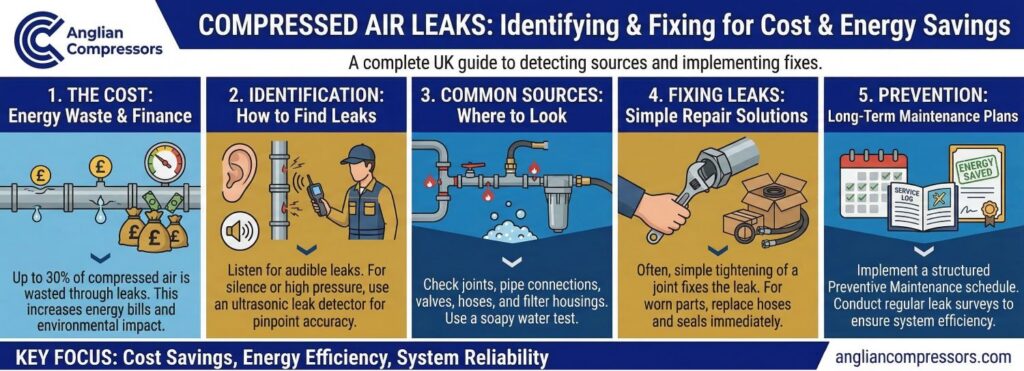
Compressed air leaks are a primary source of energy waste in UK industrial systems, with losses reaching up to 50 per cent of generated power. Undetected leaks force compressors to operate for longer periods, increasing electricity consumption, accelerating component wear, and raising operating costs without improving output.
This article explains why air compressors leak, where faults most commonly occur, and how leaks can be identified and prevented. It is written to support maintenance and operations teams seeking to improve efficiency, compliance, and asset life, drawing on field experience from Anglian Compressors.
Scale of the Problem
The British Compressed Air Society (BCAS) reports that unmanaged systems lose 30% to 50% of generated air to leakage. In a typical UK manufacturing environment, these losses represent the largest single opportunity for energy reduction.
| Leak Orifice Size (mm) | Annual Cost (£) | Operational Impact |
| 1.0 mm | £200 | Minor pressure fluctuations |
| 3.0 mm | £1,000 | Increased compressor cycling |
| 6.0 mm | £5,500 | Significant system pressure drop |
Note: Calculations assume 24/7 operation at average UK non-domestic electricity rates of £0.34/kWh.
Common Causes of Air System Leakage
Mechanical failure and environmental wear are the primary drivers of air loss. The majority of faults occur at connection points where vibration and thermal cycling degrade seals.
- Seal Degradation: Heat and pressure cycles cause elastomers in gaskets and O-rings to harden and crack, compromising the airtight seal.
- Vibrational Loosening: Constant mechanical vibration from the plant floor or the compressor motor gradually loosens threaded pipe joints and fittings.
- Hose Fatigue: Flexible polymer hoses develop micro-fractures and splits when exposed to UV light, high temperatures, or chemical vapours.
- Coupler Wear: The internal seals in quick-disconnect couplings degrade through repeated mechanical engagement and disengagement.
The “Dirty Thirty” Concept
The “Dirty Thirty” refers to the final 30 feet of pipework between the main distribution header and the pneumatic tool. This section contains the highest concentration of potential leak points, including secondary regulators, lubricators, and flexible hoses. Operational movement in this area makes it the most frequent source of system air loss.
Internal Compressor Faults
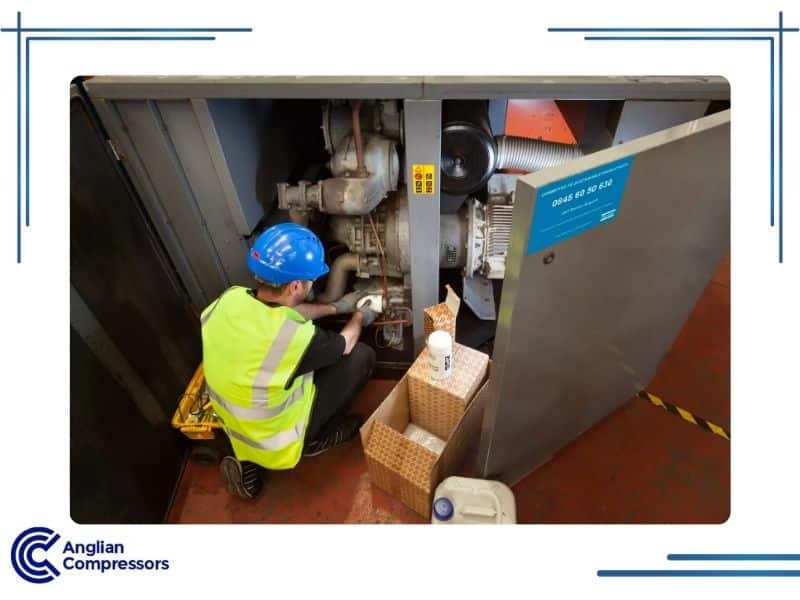
While the distribution network is the primary source of leakage, internal component failures within the compressor package also impact efficiency.
Rotary Screw Systems
In oil-injected screw compressors, such as the Atlas Copco GA range, a faulty Minimum Pressure Valve (MPV) allows air to leak back from the factory pipework into the compressor after shutdown. Degraded internal control air tubing can also cause the machine to cycle incorrectly.
Reciprocating Systems
Piston compressors are susceptible to cylinder head gasket failure due to high thermal stress. Worn piston rings lead to “blow-by,” where air escapes into the crankcase, reducing the amount of usable air the compressor can deliver to the system.
Ranked Leak Detection Methodologies
Effective detection requires selecting tools based on the operational environment and the required precision.
- Ultrasonic Acoustic Detection: The professional standard. It identifies high-frequency sounds (38-42 kHz) produced by escaping air. This allows for pinpointing leaks during active production without interference from background noise.
- Soapy Water Testing: A manual diagnostic method. Applying a surfactant solution to joints identifies leaks through bubble formation. This is effective for confirming suspected leaks but is insufficient for plant-wide audits.
- Thermal Imaging: A situational diagnostic. It detects temperature gradients caused by the Joule-Thomson effect as air expands. It is less effective for micro-leaks than ultrasonic sensors.
A comprehensive compressed air energy audit identifies these losses and establishes a baseline for system remediation.
Statutory Obligations: PSSR 2000
The Pressure Systems Safety Regulations 2000 (PSSR) govern the operation of compressed air systems in the UK. Systems operating above 0.5 bar require a Written Scheme of Examination (WSE). Unresolved leaks in main headers or pressure vessels are safety risks that may indicate structural degradation. Failure to address these faults can trigger HSE enforcement and invalidate business insurance. Adhering to UK compressed air regulations is a mandatory requirement for industrial operators.
Prevention and Mitigation Measures
Proactive infrastructure choices reduce the emergence of new leaks and lower the total cost of ownership.
- Modular Aluminium Piping: Replacing galvanised steel with systems like AIRnet eliminates internal corrosion and reduces the number of threaded joints.
- Remote Monitoring: Digital platforms such as SMARTLINK track load/unload ratios to identify rising base loads indicative of new leaks.
- Pressure Optimisation: Reducing system pressure to the minimum required level decreases the volume of air lost through existing orifices.
- Scheduled Maintenance: Regular air compressor repair and part replacement cycles prevent seal and gasket failure.
Anglian Compressors provides professional air leak detection surveys to quantify system losses and identify necessary corrective actions.
Would you like me to generate a specific technical specification for an AIRnet piping installation or a PSSR 2000 compliance checklist? Contact us today.