

Choosing the Right Air Hose for Your Compressor
The most expensive component in your compressed air system is not necessarily the compressor. It’s the hose connecting it to your tools. A single undersized air hose can strip up to 50% of the torque from a 1/2″ impact wrench, and operators compensating by raising compressor pressure add around 7% to energy costs for every additional bar demanded.
Choosing the right air hose for your compressor is an engineering decision with direct financial consequences.
As Atlas Copco’s Premier Distributor since 1977, now operating as Anglian Compressors (a Branch of Atlas Copco Compressors), we’ve specified compressed air infrastructure across manufacturing, precision engineering, automotive, and construction sites throughout East Anglia, the East Midlands, and beyond.
This guide covers hose size, material, pressure ratings, couplings, and sector-specific recommendations. But experienced readers can jump directly to the couplings or safety compliance sections.
Why the Air Hose Is the Lifeblood of Your Compressed Air System
Capital investment in a high-efficiency compressor means nothing if the hose delivering that air is incorrectly specified.
Compressed Air: The Fourth Utility UK Industry Cannot Afford to Waste
Compressed air sits alongside electricity, water, and gas as the fourth utility powering UK industry. Yet while compressors receive careful specification, the hose is routinely treated as a commodity.
How a Single Hose Choice Undermines a Premium Compressor Investment
The Darcy-Weisbach equation governs pressure drop in turbulent flow: resistance is inversely proportional to internal diameter raised to the fifth power (D⁵). A reduction from 10mm to 6mm bore increases flow resistance by a factor of around 7.6, invisible to the eye but catastrophic to tool output.
Most operators assume unexplained energy cost increases are a compressor efficiency problem. In reality, hose restriction forces the air compressor to operate at elevated discharge pressure to compensate, and a site running an Atlas Copco GA series rotary screw compressor at 7.5 bar instead of 6.5 bar for this reason pays roughly £200–£400 per year in additional electricity (source) from a hose costing less than £50 to replace.
Our SMARTLINK remote monitoring technology routinely identifies unexplained pressure differentials between compressor discharge and tool inlet, in the majority of cases, the root cause is an undersized or degraded hose assembly.
What Size Air Hose Do You Need? Matching Internal Diameter to Tool Demand
Hose size is determined by the tool’s air volume demand, not the compressor’s output pressure.
Internal Diameter vs. Outer Diameter: The Measurement That Actually Matters
Internal diameter (I.D.) governs airflow capacity and pressure drop. Most operators assume that matching the thread size of the tool’s air inlet port is enough for sizing a hose. Technicians commonly size hoses by that thread size, if the port is 1/4″ BSP, they fit a 6mm hose. This is wrong.
The BSP thread size refers to the original pipe bore, not the hose flow bore. A 6mm I.D. hose will choke any tool consuming more than 3 CFM, and the D⁵ relationship means even a modest bore reduction creates a severe restriction. An impact wrench rated at 15 CFM run through a 6mm hose loses up to 50% of rated torque, representing a direct production loss on every fastening cycle.
Our AIRScan data logging can confirm actual flow demand at each drop point before you commit to a bore size.
Hose Size by Tool Type: A Practical Reference Table for UK Workshops
Match your CFM requirements for your tools to the correct bore before specifying a single metre of hose.
| CFM Range | Recommended I.D, and | Typical Tools | Pressure Drop Risk |
| 1–3 CFM | 6mm (1/4″) | Blow guns, nailers, airbrushes | Low if hose is short |
| 3–10 CFM | 8–10mm (5/16″–3/8″) | Drills, ratchets, grease guns | Moderate |
| 10–20 CFM | 10–13mm (3/8″–1/2″) | Orbital sanders, 1/2″ impact wrenches | High if undersized |
| >20 CFM | 13–19mm (1/2″–3/4″) | Large grinders, jackhammers | Severe if undersized |
Pushing 15 CFM through 10 metres of 6mm hose produces a pressure drop potentially exceeding 20–30 psi (source). Through a 13mm hose at the same flow and run length, the pressure drop falls below 1 psi.
Does Hose Length Affect Air Pressure? Understanding Pressure Drop Across Long Runs
Yes, and the relationship is exact. A 30-metre hose produces precisely double the pressure drop of a 15-metre hose of identical diameter and flow rate. Every fitting, bend, and coupling adds resistance equivalent to additional metres of straight hose, a concept known as equivalent length.
Why Flexible Hose Should Only Cover the Final Drop, Not the Full Run
Flexible hoses belong only at the final 2–5 metre drop to the tool. The main distribution network should use fixed, smooth-bore piping. The Atlas Copco AIRnet aluminium piping system, corrosion-free, smooth-bore, with leak-free press fittings, delivers a friction coefficient close to zero compared to rubber hose.
Rubber used across a 50-metre distribution run can introduce a cumulative pressure drop exceeding 1 bar, triggering the 7% energy penalty per bar. Hose connections along long runs are also the most common sites for air leaks. This can waste up to 30% of the generated compressed air (source). Our ultrasonic Leak Detection Service surveys connection points, tags every leak, and provides a quantified savings report.
Which Hose Material Is Best? Rubber, PVC, Polyurethane, and Hybrid Compared
Material selection is a safety decision before it’s a cost decision. The wrong material in the wrong environment creates a PUWER 1998 compliance failure.
The UK Winter Test: Why Hose Material Is a Safety Decision, Not Just a Cost Decision
PVC stiffens dramatically as temperatures approach 5°C. It retains coil memory, becomes a rigid trip hazard, and can crack at the coupling ferrule without visible warning. A cracked PVC hose at 7 bar fails catastrophically, producing a whipping hose and a pressure injection risk. Under PUWER 1998, deploying a hose specified for heated environments in an unheated workshop is a documented compliance failure.
Polyurethane (PU) is around 25% of the weight of rubber, performs to -20°C, and resists oils and cutting fluids. Hybrid polymer hoses blend PVC and rubber characteristics for general workshop use.
| Material | Cold Flexibility | Lay-Flat | Abrasion Resistance | Oil Resistance | Primary Use |
| Rubber | Excellent (-30°C) | Excellent | Excellent | Good | Heavy industry, outdoor |
| PVC | Poor (stiff <5°C) | Poor | Moderate | Poor | Light indoor only |
| Polyurethane | Good (-20°C) | Good | Excellent | Excellent | Assembly, mobile |
| Hybrid | Very Good | Very Good | Good | Good | General workshop |
Atlas Copco TURBO Hose: Heavy-Duty Performance Without the Weight Penalty
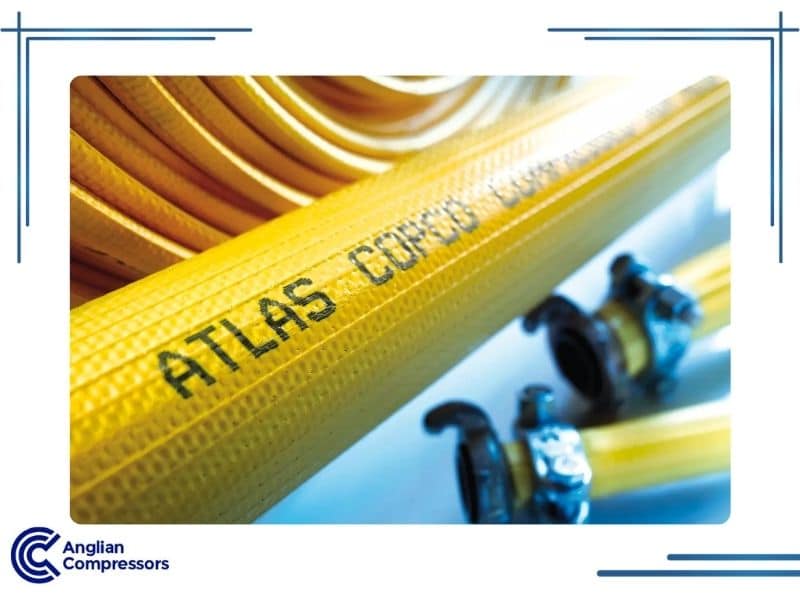
The Atlas Copco TURBO Hose uses advanced rubber compounds and high-tensile reinforcement, maintaining flexibility from -30°C to +70°C, with full oil and spark resistance, at significantly reduced mass. Available in 13mm (1/2″) to 25mm (1″) diameters, it’s the specification-grade choice for foundries, construction sites, and unheated workshops where PVC is a liability.
Which Air Hose Coupling Do You Need? The UK Compatibility Problem Explained
A correctly specified hose terminated with a restrictive or leaking coupling delivers none of its engineered performance. Quality fittings and connections are as critical as the hose bore itself.
PCL Standard vs. Euro Profile: Why These Two Couplings Must Never Be Mixed
PCL Standard (AC21 series) has a long, thin male plug and smaller internal bore, adequate for light tools but restrictive above 10 CFM. Euro (XF-Euro) profile (PCL AC71 series) has a shorter, wider plug with a 7.2–7.4mm internal bore and significantly higher flow capacity. Mixing them is dangerous: a Standard plug in a Euro socket is too narrow to seal, creating a hose whip risk. A workshop that upgrades to a 13mm hose but retains PCL Standard hose connectors recovers only a fraction of the performance gain; the coupling bore becomes the new bottleneck.
ErgoQIC and SmartQIC: The Performance and Safety Upgrade Hidden in Plain Sight
The Atlas Copco ErgoQIC coupling uses a full-bore ball valve mechanism, eliminating the poppet valve restriction found in standard couplings and delivering virtually zero pressure drop, allowing compressor discharge pressure to be reduced without loss of tool output.
The Atlas Copco SmartQIC safety coupling meets ISO 4414: the first push vents downstream pressure. The second push releases the nipple only after depressurisation, eliminating hose whip entirely. ISO 6150 governs the design and testing of quick-release couplings and should be referenced when specifying coupling safety requirements.
Working Pressure Ratings, Safety Compliance, and UK Regulations Every Operator Must Know
Compressed air hose assemblies in the UK fall under multiple overlapping regulatory frameworks. Refer to the HSE’s guidance on compressed air safety (HSE HSG39) as the primary operational reference.
Worm-Drive Clamps, Whip Hoses, and the HSE Rules That Govern Compressed Air Safety
Worm-drive (Jubilee-style) clamps are not compliant for compressed air hose terminations. The tightening screw creates a non-uniform pressure point, a leak path, and the serrated band can cut into the hose’s outer cover under pressure pulses. The screw mechanism also vibrates loose over time. Compliant alternatives are O-clips (2-ear clamps) or crimped ferrules, providing permanent, uniform 360-degree sealing.
HSE HSG39 recommends that the quick-release coupling plug be fitted onto a short isolation whip hose of a minimum of 300mm, as specified in ISO 6150. At pressures as low as 30 psi (2 bar), compressed air can penetrate the skin and cause a fatal air embolism (source).
PSSR 2000, PUWER 1998, and BS EN ISO 4414: What UK Employers Are Legally Required to Do
PSSR 2000 Regulation 4 requires that a Written Scheme of Examination covers all protective devices, including hose assemblies above the threshold pressure-volume product, carried out by a Competent Person at defined intervals. If a hose assembly fails and injures an operator and the employer can’t produce a Written Scheme of Examination, the HSE treats its absence as a primary regulatory breach. Unlimited liability follows under PSSR 2000.
As a Competent Person under PSSR 2000, holding CHAS and SafeContractor accreditation, Anglian Compressors (a Branch of Atlas Copco Compressors) can carry out Written Scheme of Examination reviews covering hose assemblies, fittings, and connection points.
Which Air Hose Is Right for Your Industry? A Sector-by-Sector Guide
Automotive, Construction, and Assembly: Matching Flexible Hose to the Working Environment
Automotive workshops need a minimum 10mm (3/8″) I.D. for 1/2″ impact guns. Euro (AC71) or ErgoQIC couplings are non-negotiable, PCL Standard is too restrictive for modern impact tools. Fit a whip hose on all impact wrenches to protect couplings from vibration fatigue.
Construction sites demand the Atlas Copco TURBO Hose in 13mm (1/2″) minimum for jackhammers; it must survive concrete and vehicle traffic. PVC is strictly non-compliant for outdoor UK winter use.
Industrial assembly lines benefit from polyurethane (PU) for operator comfort. SmartQIC safety couplings are mandatory in crowded spaces. Atlas Copco HM Hose Reels, mounted overhead, keep floors clear and reduce coupling strain.
Food Production and Pharmaceutical: When Hose Material Becomes a Compliance Requirement
ISO 8573-1 classifies compressed air quality at the point of use, not at the compressor discharge. A rubber hose with residual oil contamination recontaminates the air stream between an oil-free compressor and the tool. A BRCGS audit identifying contamination will result in a non-conformance regardless of the compressor’s oil-free certification.
The Atlas Copco ZR/ZT oil-free compressor solves the generation side. The hose must be specified to match. HTM 02-01 governs compressed air quality across the entire distribution system in UK healthcare settings, including flexible hose assemblies.
Request an Air Audit to receive a written hose and coupling specification for your site.
Before specifying a single metre of hose, walk your system and note:
1. The internal diameter is marked on every hose in use.
2. The coupling profile at each drop point.
3. The length of your longest single hose run in metres.
If any of these reveals a mismatch, contact Anglian Compressors (a Branch of Atlas Copco Compressors) to request an Air Audit.
Frequently Asked Questions
What size air hose do I need for my compressor?
Size is determined by the tool’s CFM demand. Use 6mm (1/4″) for blow guns and nailers. 10mm (3/8″) for impact wrenches and sanders. 13mm (1/2″) for grinders and jackhammers above 20 CFM. Always measure internal diameter, it’s the only dimension governing airflow and pressure drop.
Which material is best for air hoses?
Rubber suits for outdoor and heavy industrial use, flexible to -30°C, oil- and spark-resistant. Polyurethane suits assembly lines, lightweight and good to -20°C. PVC is only appropriate for light-duty heated indoor use. Hybrid polymer is a practical general-workshop compromise.
Does hose length affect air pressure?
Yes. Friction loss is linear with length, a 30-metre hose produces exactly double the pressure drop of a 15-metre hose at the same diameter and flow rate. Limit the flexible hose to the final 2–5 metre drop and use Atlas Copco AIRnet aluminium for the main distribution run.
What is the difference between PCL Standard and Euro adaptor profiles?
PCL Standard (AC21 series) has a smaller bore, adequate for light tools but restrictive above 10 CFM. Euro (XF-Euro, AC71 series) has a 7.2–7.4mm bore and higher flow capacity. The profiles are incompatible; mixing them causes leaks and hose whip risk. Most UK industrial sites are moving to Euro or Atlas Copco ErgoQIC full-flow couplings.
What are the UK regulations for compressed air hoses?
Three frameworks apply: PSSR 2000 (Written Scheme of Examination by a Competent Person). PUWER 1998 (hose must suit its working environment). And BS EN ISO 4414 (safe use including hose whip prevention). HSE HSG39 provides primary operational guidance. Worm-drive clamps are not compliant for compressed air hose terminations.
What is the best air hose for cold weather use in the UK?
Rubber maintains full flexibility to -30°C. The Atlas Copco TURBO Hose delivers rubber’s cold-weather performance at significantly reduced weight. Polyurethane performs adequately to -20°C. PVC must not be used in unheated workshops or outdoors in winter, it stiffens below 5°C and can crack at the ferrule under pressure.