

Why Does My Air Compressor Keep Tripping the Circuit Breaker?
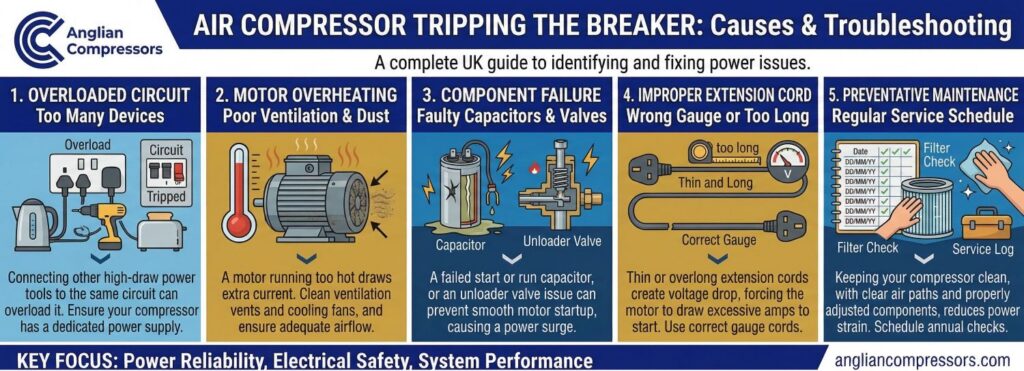
Air compressors trip circuit breakers when the motor current exceeds the protective device threshold, indicating an electrical overload, short circuit, or abnormal mechanical load. Repeated tripping disrupts operations and signals a fault that can damage motors, cabling, and control systems if left unaddressed.
This article explains the most common causes of breaker tripping in industrial compressor installations, including inrush current, protection selection, voltage drop, and mechanical resistance. It also outlines diagnostic approaches used by Anglian Compressors to identify root causes and reduce unplanned downtime.
Why is the circuit breaker tripping?
A circuit breaker protects electrical circuits by interrupting power flow during fault conditions. It operates via two primary mechanisms: thermal overload protection for sustained overcurrent and magnetic instantaneous tripping for short circuits or high fault currents.
These interruptions typically originate from four categories: electrical supply faults, protection/matching faults, motor starting faults, and mechanical load faults. Each trip causes stoppage and increases maintenance and energy costs through repeated high-current starts.
How does electrical infrastructure affect breaker performance?
Industrial air compressors are inductive loads. They require a high surge of current during startup, defined as inrush current. Standard Type B breakers are often unsuitable for these profiles, as their magnetic trip threshold is too low for industrial motor demands.
Installers typically specify Type C or Type D breakers for industrial motors, subject to verification of inrush currents and manufacturer data.
Undersized cabling leads to voltage drop. In induction motors, significant undervoltage can reduce starting torque, extend acceleration time, and increase current draw to maintain the required load. BS 7671 Regulation 525.1 recommends a maximum voltage drop of 5% for power circuits under normal load conditions.
What causes high inrush current and locked rotor states?
The transition from a stationary state to full speed is the most demanding period for a compressor. A locked rotor state occurs when the motor fails to turn despite receiving power. Observable symptoms include a loud hum without rotation followed by a rapid trip of the instantaneous element or motor protection relay.
Star-delta starting systems reduce this initial demand but introduce complexity. Faults in the transition, such as incorrect timing, contactor wear, or phase issues, cause transient current spikes. These faults are best verified via start current capture analysis. Variable speed drives (VSD) and soft-start technologies, such as those in Atlas Copco GA VSD+ models, eliminate massive inrush spikes compared to Direct-On-Line (DOL) or star-delta starting.
Can mechanical resistance cause electrical trips?
Mechanical faults often manifest as electrical overcurrent events. High internal friction in the air-end forces the motor to work harder, drawing more power. Worn bearings or rotor-to-housing contact increase the mechanical torque requirement beyond safe limits.
Specific mechanical causes for breaker trips include:
- Unloader Valve Failure:
- Cause: Valve sticks in the closed position.
- Electrical Effect: Motor attempts to start under load (high inrush).
- Verification: Check valve operation and tank pressure gauge during the start cycle.
- Check Valve Failure:
- Cause: Valve fails to seal.
- Electrical Effect: Backpressure from the air receiver resists rotor rotation.
- Verification: Monitor pressure decay at the air-end during shutdown.
- Clogged Oil Separator:
- Cause: Saturated filter element.
- Electrical Effect: Increased motor load required to overcome restriction.
- Verification: Measure differential pressure across the separator.
- System Pressure Drop:
- Cause: Restrictions or high set-points.
- Electrical Effect: As a rule of thumb, higher system pressure and restrictions increase power demand; the exact relationship depends on compressor type and operating point.
How do diagnostics identify faults?
Many industrial compressors use electronic controllers and remote monitoring to isolate faults quickly. Atlas Copco compressors utilise Elektronikon controllers to monitor system health and generate specific fault codes. The SMARTLINK platform enables remote analysis of performance trends.
The primary electrical fault codes include:
- Overcurrent (OC): Indicates a sudden load spike or internal short circuit.
- Phase Loss: Signals the disconnection of one power phase.
- Ground Fault: Detects current leakage to earth.
How does cold weather impact breaker tripping?
Lower ambient temperatures increase the viscosity of lubricating oil. UK winters cause compressor oil to become thicker in unheated environments. Thick oil creates significant mechanical drag during startup, causing the motor to draw excessive current. Practical mitigations include ensuring the correct oil grade for the ambient temperature, utilizing crankcase heaters, maintaining a warmed enclosure, or following a controlled start procedure.
What are the UK regulatory requirements for electrical faults?
The Provision and Use of Work Equipment Regulations (PUWER) 1998 establishes a duty to maintain equipment in a safe condition. A compressor that frequently trips its breaker suggests the equipment is no longer operating within safe parameters. The Pressure Systems Safety Regulations (PSSR) 2000 include expectations for the inspection and maintenance of protective devices. This includes ensuring electrical trips and pressure switches function correctly to protect personnel and plant.
Addressing persistent system faults
Do not force a machine to start if the breaker trips immediately after a reset. Repeated attempts escalate fault energy and increase thermal stress on the motor. These symptoms are indicators of common air compressor failures such as blown start capacitors or winding faults.
Persistent breaker trips indicate a system fault that requires professional diagnosis. Anglian Compressors supports industrial sites across East Anglia and the Midlands with diagnostics, compliance-led repair, and mechanical fault resolution to ensure long-term system reliability. Professional air compressor repair.